

When shopping for energy-efficient replacement windows in harsh, cold climates, homeowners frequently encounter marketing claims surrounding foam-injected vinyl frames. Sales presentations often feature corner cross-sections filled with polyurethane foam, framed as the pinnacle of modern insulation technology.
However, modern fenestration engineering tells a very different story. While foam insulation sounds intuitive, injecting foam into unplasticized polyvinyl chloride (uPVC) profiles introduces distinct structural, thermal, and long-term durability trade-offs.
1. Structural Rigidity: Webbing vs. Foam Core
The internal architecture of a premium uPVC window profile relies on extruded internal webs that divide the profile into 5 to 7 dedicated, engineered chambers.
- Internal Load Distribution: These internal vinyl walls act as continuous structural gussets. They resist wind loads, prevent frame deflection under the weight of heavy triple-pane Insulated Glass Units (IGUs), and maintain squareness over decades of operational cycles.
- The Foam Extrusion Trade-Off: To inject foam uniformly at the factory level without creating massive air voids, manufacturers often consolidate small chambers into fewer, oversized cavities. Replacing rigid uPVC structural webs with low-density expanded polyurethane compromises the frame’s moment of inertia, leading to sash sag and frame racking.
- Hardware Anchoring: Critical hardware, including multi-point locks, heavy-duty hinges, and keeper plates, requires anchoring screws to bite through multiple internal vinyl walls or internal steel reinforcement channels. Foam provides virtually zero screw-retention strength (pull-out resistance).
2. Solar Heat Gain & Dark Exterior Finishes: Why Internal Webs Matter
Dark window frames (such as matte black, charcoal, and bronze) have become the modern architectural standard. However, dark surfaces absorb significantly more solar radiation, generating extreme surface temperatures up to 65°C to 75°C (150°F to 167°F) on hot summer days.
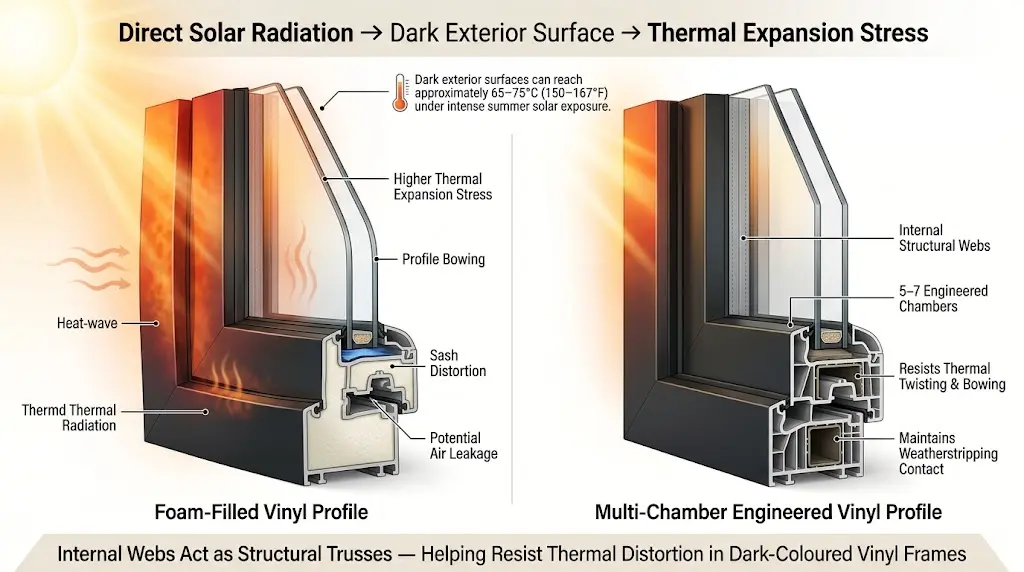
[Direct Solar Radiation on Dark uPVC Profile]
│
▼
[Extreme Thermal Expansion Stress]
│
┌────────────────┴────────────────┐
▼ ▼
[Foam-Filled Profile] [Multi-Chamber Engineered Profile]
(Fewer internal webs) (5 to 7 structural web chambers)
│ │
▼ ▼
- High risk of profile warping • Webs act as internal trusses
- Sash distortion & air leaks • Resists thermal twisting & bowing
- Failed weatherstripping seal • Factory-grade structural stability
- The Dark Window Challenge: Painting or laminating a structurally compromised, foam-filled frame in black is essentially an engineering disaster waiting to happen. Without internal vinyl webs to counter thermal expansion, the differential heat between the exterior and interior faces causes the profile to bow, warp, and break weatherstripping contact.
- The Panorama Windows & Doors Standard: Because we build around robust, multi-chambered vinyl extrusions with rigid internal webbing, our frames easily handle the intense thermal stresses of dark coatings. These internal webs act as rigid trusses that prevent thermal distortion, allowing us to finish windows in modern dark colours with complete structural confidence.
3. Hydrodynamics and the Freeze-Thaw Mechanism
Windows are dynamic water-management systems. Exterior glazing channels and frame recesses are engineered to capture incidental moisture from wind-driven rain or internal condensation and route it back outside via sloped sill profiles and calibrated weep systems.
[Exterior Moisture / Condensation]
│
▼
[Weep Holes & Drainage Path] ────► Clogged by Foam? ──► Trapped Moisture
│ │
▼ (Normal Operation) ▼ (Winter Sub-Zero)
[Discharged to Outside] [Freeze-Thaw Expansion]
│
▼
- Frame Warping & Corner Weld Cracking
- Glazing Pocket Hydrostatic Pressure
- Premature IGU Seal Failure
When liquid moisture bypasses outer gaskets and encounters open- or closed-cell foam inserts, capillary action and surface tension trap water against the internal vinyl walls.
In sub-zero Canadian winter conditions, trapped liquid freezes and expands by approximately 9% in volume. This creates internal hydrostatic pressure within the glazing channel, leading to:
- Warped sash and frame profiles, resulting in drafty air infiltration.
- Micro-fissures in welded vinyl miter joints (corner welds).
- Point-load stress on the perimeter edge seal of the IGU, accelerating desiccant saturation and premature seal failure.
4. The 90/10 Thermal Distribution Law
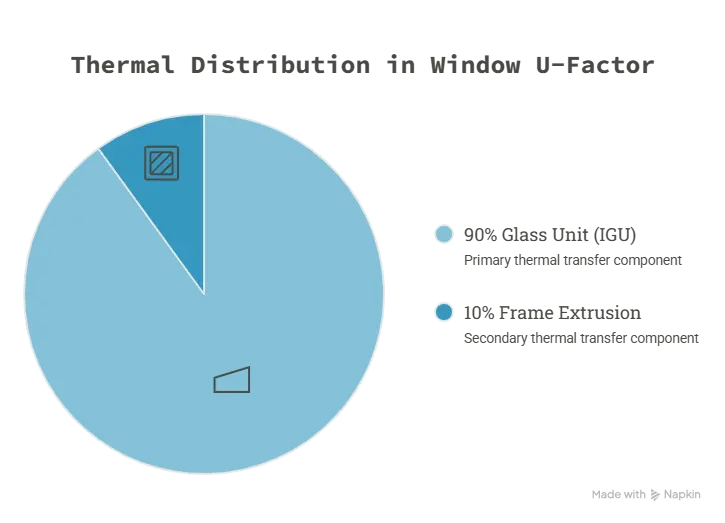
A common misconception is that the window frame represents the primary avenue of household thermal transfer. In reality, the frame and sash comprise only 10% to 15% of the total window aperture area, while the IGU accounts for 85% to 90%.
| Component | Engineering Focus Area | Impact on Total Window U-Factor |
| Glass Unit (IGU) | Low-E coatings, Argon/Krypton fill, Warm-edge composite spacers | ~85% to 90% |
| Frame Extrusion | Multi-chamber uPVC geometry, chamber depth, dead air stratification | ~10% to 15% |
| Foam Infill | Micro-convection damping inside frame cavities | < 1% to 2% net gain |
Multi-chamber profiles already leverage trapped dead air, which has an exceptionally low thermal conductivity (k ≈ 0.026 W/m·K). By keeping individual chamber dimensions narrow (typically under 12 to 15 mm), natural convective air loops within the frame are effectively suppressed.
Injecting foam into an already optimized multi-chamber profile yields a negligible improvement in overall whole-window U-factor (often less than 0.01 W/m²·K), while sacrificing structural rigidity and moisture evacuation.
5. Differential Thermal Expansion and Internal Corrosion
Materials expand and contract at different rates when exposed to ambient temperature cycles (ΔT).
- Coefficient of Thermal Expansion (CTE): uPVC expands and contracts significantly between summer and winter. Over time, shear stresses cause internal foam to debond from vinyl walls, creating interstitial micro-channels where condensation collects.
- Corrosion of Galvanized Reinforcement: Heavy commercial-grade vinyl windows incorporate internal galvanized steel channels to withstand high design pressures. When foam traps humidity against internal steel stiffeners without adequate air circulation, the protective zinc coating degrades, causing latent internal rust that compromises structural fasteners.
Summary
High-performance fenestration relies on balanced physical principles rather than isolated marketing add-ons.
Precision-engineered multi-chamber uPVC profiles, paired with high-spec triple glazing, advanced Low-E stacks, and unimpeded water drainage, deliver superior thermal insulation, maximum structural lifespan, and the rigidity needed for premium dark exterior finishes without the liabilities of foam injection.
Get a Multi-Chamber Vinyl Window Quote
We build and install multi-chamber vinyl frames every day across Ontario. Book a free in-home consultation for window replacement in Barrie or window installation in Barrie, or contact Panorama Windows & Doors to talk through frame construction with an installer. Ask about the window and door rebate programs you may qualify for.
Window Styles We Build
- Vinyl Windows: multi-chamber uPVC extrusions with rigid internal webbing.
- Triple-Pane Windows: the 85 to 90% of the aperture that actually drives U-factor.
- Low-E Windows: coatings that reflect up to 96% of heat and light energy.
- Energy-Efficient Windows: argon fill, warm-edge spacers, and tight weatherstripping.
- Casement Windows and Awning Windows: triple-sealed, weather-tight operation.
- Slider Windows, Double Hung Windows, and Picture Windows.
- Patio Doors, Fiberglass Entry Doors, and Steel Entry Doors.
Windows and Doors Service Areas
Our installers come to you. Here is where we work across Ontario:
- Window Replacement in Sudbury Window Installation in Sudbury · Door Replacement in Sudbury · Door Installation in Sudbury
- Window Replacement in Hamilton Window Installation in Hamilton · Door Replacement in Hamilton · Door Installation in Hamilton
- Window Replacement in Oshawa Window Installation in Oshawa · Door Replacement in Oshawa · Door Installation in Oshawa
- Window Replacement in Burlington Window Installation in Burlington · Door Replacement in Burlington · Door Installation in Burlington
- Windows and doors in Kitchener, Oakville, Mississauga, Brampton, Markham, Richmond Hill, Newmarket, Aurora, Orillia, Wasaga Beach, Collingwood, Innisfil, Waterloo, and London.
Related Reading
- Benefits of Triple-Pane Windows for Ontario Winters
- The Window Energy Rating Trap
- Best Window Styles for Maximum Insulation in Ontario
- How to Stop Ice Buildup on Windows in Ontario
- What Causes Moisture Around Windows
- Vinyl vs. Wood Windows
- Window and Door Design Trends
- Common Window Problems in Ontario Homes
- Reasons to Replace Windows in Ontario
- Window Replacement Cost in Ontario
Written by Alex Soroka, Senior Project Manager.