


Fiberglass holds up best against extreme freeze-thaw cycling. A high-density polyurethane foam core inside a fiberglass slab delivers a thermal insulation rating of R-5 to R-6, cutting conductive heat loss to a fraction of what an uninsulated door lets through. The fiberglass skin also runs warmer than steel on a cold day, so the interior face resists the condensation that beads on a metal slab once the outside temperature drops below freezing.
Solid wood moves with moisture rather than temperature, swelling and warping across a Canadian year, and it delivers a minimal rating of R-2 to R-3.
An insulated steel door carries the same R-5 to R-6 core rating as fiberglass. The slabs are closer than the brochures suggest. Steel loses ground at the skin and the edges, where metal conducts cold straight through, and at any scratch that lets road salt reach bare steel. In a high-moisture setting, a coastal region, a heavy snow zone, a humid valley, that is what decides it. There’s a fuller comparison of the two materials under Ontario conditions if you’re weighing them side by side.
Cold Climate Installation Protocol
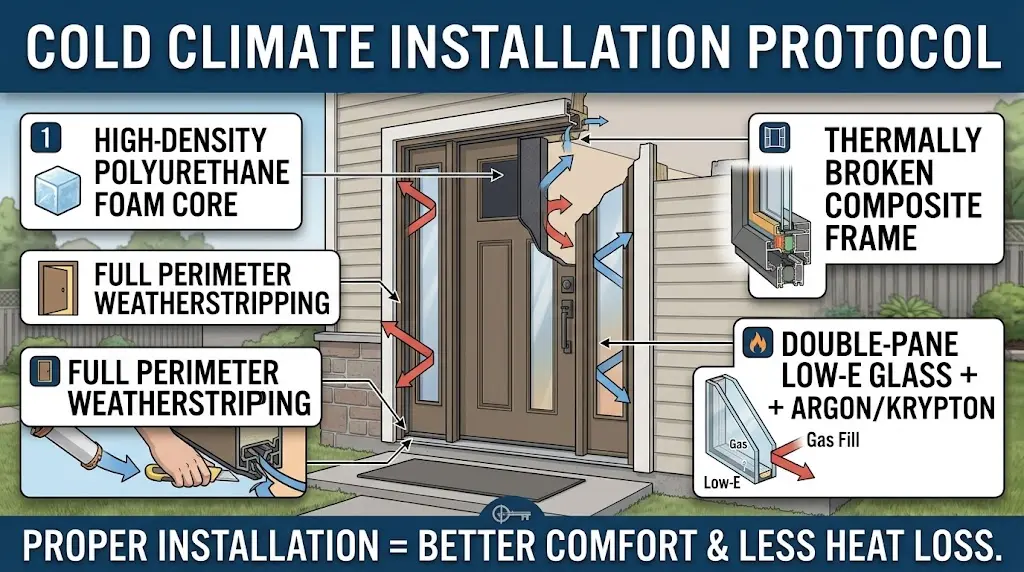
The slab is only half the job. Fitting the assembly square and sealed in Barrie is what stops cold air slipping past the door you just paid for. Four components do the work:
- Integrate a high-density polyurethane foam core to block thermal conduction.
- Apply a full perimeter weatherstripping system, a compression seal at the jamb, a sweep at the threshold, and a Q-Lon or magnetic gasket where the slab meets the stop.
- Mount a thermally broken composite frame to cut frost transfer at the jamb.
- Insert a double-pane Low-E glass lite, argon or krypton filled, to reduce radiant heat loss where the design includes a window.
Which One For Your Entry?
Exposure decides more than the spec sheet does.
A south or west-facing entry takes direct sun all afternoon and cycles through a wide temperature swing every day. A dark colour absorbs more of it. That’s the opening where a steel slab eventually bows away from its weatherstrip and starts leaking air you can’t adjust out. Fiberglass is the safer buy there.
A sheltered north entry under a deep porch, in Barrie or anywhere across Simcoe County, asks far less of the door. Insulated steel is honest value on that opening.
Book a free in-home consultation and we’ll read the exposure before recommending a material. Barrie homeowners can also find the showroom on Bryne Drive
People also ask
Do You Need A Permit To Replace Windows Or Doors In Ontario?
Find out if you need a building permit to replace windows or doors in Ontario. Learn the Ontario Building Code rules for like-for-like replacements, structural.
What Should I Look for in a Window Replacement Company in Oshawa, ON?
Discover essential tips for choosing the right window replacement company in Oshawa. Get expert installation and quality service for your window and door needs!