

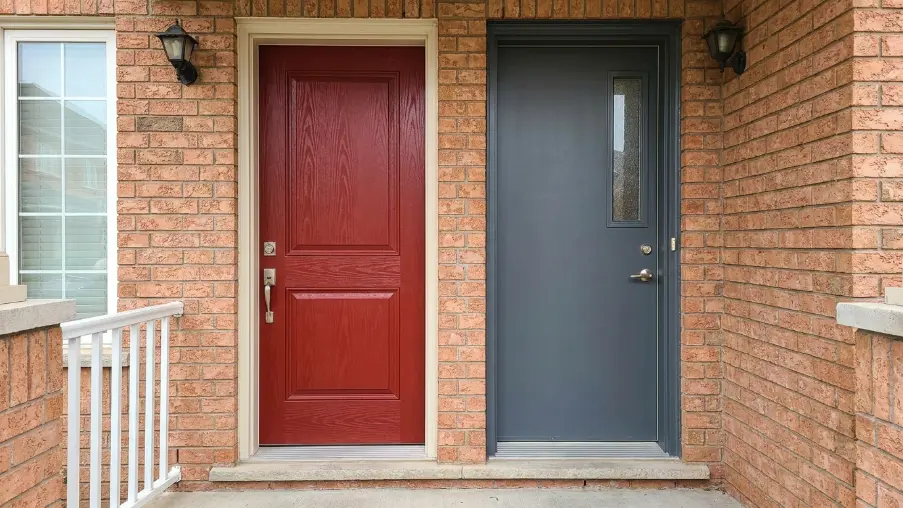
For most Ontario homes, fiberglass doors suit energy efficiency and low upkeep, while steel doors suit security and a lower upfront price. Your entry’s exposure settles the rest.
Your front door faces a lot here. Freeze-thaw swings, road salt, humid summers, and sub-zero snaps all test it daily. As a result, a drafty or rusting entry door quietly drains heat and curb appeal for years. So the real choice is matching the material to your climate, your budget, and how the door gets used. Read on to see exactly which one fits your home.
Fiberglass vs Steel: Quick Comparison Table
Here is how fiberglass and steel doors compare across the factors that matter most.
| Factor | Fiberglass Doors | Steel Doors |
| Upfront cost (installed) | $2,500-$4,500+ | $2,000-$3,500 |
| Energy efficiency | Higher (R-5 to R-7) | Good (R-5 to R-6) |
| Security | Strong with good locks | Strongest against forced entry |
| Maintenance | Very low | Needs rust touch-ups |
| Cold-climate performance | Stable, will not rust | Good, can frost or rust |
| Appearance | Real wood-grain look | Smooth, painted finish |
| Typical lifespan | 25-30+ years | 20-30 years |
| Best use | Front and exposed entries | Side, garage, budget doors |
What Fiberglass Doors Are
A fiberglass door uses a moulded composite skin over an insulating foam core, framed in wood or composite. It resists rust, rot, dents, and warping. That combination suits harsh Canadian weather.
Manufacturers compression-mould the skin to copy real wood grain. Meanwhile, the polyurethane foam core delivers strong insulation and a tight seal.
Most quality fibreglass slabs carry an R-value near R-5 to R-7, so they hold heat well. Because fibreglass doors barely expand or contract, they stay stable through temperature swings. You can also stain or paint them to match your home.
What Steel Doors Are
A steel door uses a heavy-gauge galvanized steel skin wrapped around a polyurethane foam core. It gives the strongest resistance to forced entry. For security on a budget, few materials compete.
The steel shell, usually 20 to 26 gauge, makes the slab very hard to kick in. Inside, the foam core handles insulation and soundproofing.
However, steel doors take a painted finish rather than a stained wood look. Their main weakness is rust, since exposed scratches corrode over time, especially near road salt.
Fiberglass vs Steel: Head-to-Head Comparison
Both materials outperform wood, yet they behave very differently in real Ontario conditions. Here is how they compare factor by factor.
1. Construction
Fiberglass doors pair a compression-moulded composite skin with a dense foam core and a rot-resistant frame. As a result, the build resists moisture, swelling, and cracking through seasonal change.
Whereas steel doors wrap a galvanized steel skin around the same type of foam core. The steel adds rigidity, though the skin is thinner than most buyers expect.
2. Appearance
Fiberglass copies cedar, oak, or mahogany grain almost perfectly. You can stain it for warmth or paint it any colour. Even up close, the texture reads as real wood.
On the other hand, steel suits clean, modern, painted looks. It cannot take a stain like wood. Over time, dents tend to reveal the metal underneath.
3. Resale Value
Fiberglass entry doors lift curb appeal and help homes sell faster. Buyers respond to the wood look without the upkeep. Cost recovery typically lands around 75 to 80 percent.
Whereas steel doors return some of the strongest numbers of any exterior upgrade. Industry remodelling data often shows recovery near or above 100 percent.
4. Energy Efficiency
Fiberglass holds heat better because it does not conduct it. The foam core and tight seals keep warmth inside during cold snaps. Its surface stays stable, so the door avoids cold spots. According to Natural Resources Canada, windows, doors, and skylights account for up to 35 percent of total house heat loss.
On the other hand, steel conducts heat and cold more readily. As a result, a steel slab can feel cold or even frost in deep winter. Either way, look for the ENERGY STAR label and a low U-factor; Natural Resources Canada notes certified doors run about 15 percent more efficient than standard models.
So in the steel vs fiberglass energy debate, both work well sealed, yet fiberglass holds a slight edge at the surface. For either material, an energy-efficient entry door in Barrie only delivers when sealed correctly.
Read More: Best Front Door Options for Ontario Homes: Style Meets Security
5. Durability in Ontario Weather Conditions
Fiberglass handles rain, snow, humidity, and freeze-thaw cycles without rusting or rotting. It stays dimensionally stable through the year. Therefore, it suits our shoulder-season temperature swings particularly well.
Whereas steel struggles where snow and salt pile against the bottom. Repeated melting and refreezing speeds up corrosion on any exposed metal.
6. Security and Strength
Steel gives the strongest defence against forced entry. The heavy-gauge skin resists kicks and hard impacts. Paired with a quality deadbolt and reinforced frame, it is difficult to breach. A patio door or storm door pairs naturally with a secure steel back entry.
Whereas fiberglass is lighter and can fracture under extreme force. Even so, a reinforced frame, Grade 1 deadbolt, and clean install make it secure for most front entries. Security depends on the whole system, not the slab alone.
7. Maintenance Requirements
Fiberglass asks very little of you. A wipe with mild soap and water keeps it clean. Stained finishes need occasional re-coating, yet the door will not rust or rot.
On the other hand, steel needs closer attention. Scratches that expose bare metal must be touched up quickly. Otherwise, near salt and moisture, rust spreads fast.
8. Cost and Installation Price
Steel is the budget-friendly option. Installed front door costs often start near $2,000. For that reason, it appeals to first-time buyers and rental owners.
Whereas fiberglass sits in the mid-to-upper range, usually $2,500 to $4,500 installed. You pay more upfront, then spend less on upkeep. Glass inserts, sidelites, and a transom raise the replacement cost on either material. Either way, a pre-hung unit and installation add roughly 20 to 30 percent of the total.
10. Curb Appeal and Design Options
Fiberglass offers the widest range of looks. Wood-grain textures, stain colours, glass inserts, and sidelights all expand your choices. Together, they upgrade the whole entrance.
On the other hand, steel offers fewer design choices. It performs best in solid, modern paint colours. For a sleek, low-fuss facade, that simplicity works in your favour.
Read More: Top Reasons To Replace Windows In Ontario
What This Means for Ontario Homeowners
Local conditions should drive your final pick more than any spec sheet. Across Barrie, Oshawa, Sudbury, Hamilton, Oakville, and Kitchener, winters swing hard around the freezing mark. That repeated freeze-thaw cycle, plus road salt near driveways, is exactly what corrodes an exposed steel slab over time. Northern markets like Sudbury see deep cold snaps that make a non-conducting fiberglass door especially appealing.
Older homes across these cities add another wrinkle. Many original frames hide rot or moisture damage behind the trim. So the smart move is replacing the full system, slab and frame together. Seasoned installers know the jamb often fails before the door, which is why a composite jamb pays off.
There is also money on the table in 2026. Through the Home Renovation Savings Program, delivered by Save on Energy, Ontario homeowners can claim $100 per rough opening for an ENERGY STAR certified door.
Pair a front entry door replacement in Barrie with other upgrades to stretch the rebate further. Confirm the current terms before you buy, since program rules can change.
Advantages and Disadvantages of Fiberglass
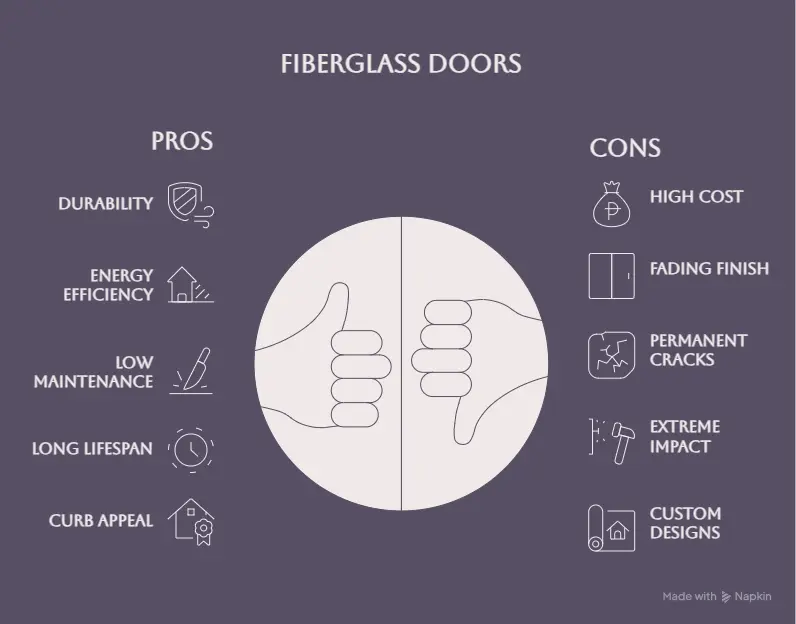
Here is a quick, honest look at where fiberglass doors perform well and where they fall short.
Pros of Fiberglass Doors
- They resist rust, rot, dents, and warping.
- They handle freeze-thaw cycles without cracking.
- They deliver excellent energy efficiency and insulation.
- They copy real wood grain convincingly.
- They need very little maintenance.
- They last 25 to 30-plus years.
- They raise curb appeal and resale value.
Cons of Fiberglass Doors
- They cost more upfront than steel.
- Stained finishes fade under strong, direct sun.
- They fade faster on south-facing entries.
- Cracks, once formed, are permanent.
- They can fracture under extreme impact.
- Premium custom designs raise the price.
Advantages and Disadvantages of Steel Doors
Steel suits many homes, yet it carries trade-offs worth knowing before you buy.
Pros of Steel Doors
- They give the strongest forced-entry resistance.
- They cost less upfront than fiberglass.
- They resist warping and cracking.
- They suit clean, modern painted finishes.
- They return strong resale value.
- They perform well under a sheltered overhang.
- They are fully recyclable.
Cons of Steel Doors
- They rust where scratches expose bare metal.
- Road salt and snow speed up corrosion.
- They feel cold or frost in winter.
- Dents are hard to repair cleanly.
- They offer fewer design options.
- They cannot take a stain like wood.
Read More: 8 Benefits of Energy-Efficient Windows For Ontario Homes To Lower Your Bills
Best Door Style for Different Home Types
The right pick depends on the entry and how it gets used. This table maps common situations to the better material.
| Home or entry type | Better choice | Why |
| Exposed front entry | Fiberglass | Resists sun, rain, and freeze-thaw |
| Sheltered porch entry | Steel | Performs well, costs less |
| Side or garage door | Steel | Security and value over looks |
| Heritage or character home | Fiberglass | Wood look without the upkeep |
| Budget-focused upgrade | Steel | Lower upfront price |
| High-end curb appeal | Fiberglass | Stain options and design range |
Fiberglass vs. Steel Doors: Which One Should You Choose?
There is no universal answer; the right door fits your entry, budget, and goals. Use these quick rules to decide with confidence, based on your home’s real needs.
Choose Fiberglass If…
- Your entry faces direct sun, rain, or snow.
- You want the lowest long-term maintenance.
- You prefer the look of real wood.
- Energy efficiency is a top priority.
- You want strong curb appeal for resale.
- You plan to stay long term.
Choose Steel If…
- Security is your number one concern.
- You want the lowest upfront price.
- Your door sits under a porch or overhang.
- You need a durable side or garage door.
- You prefer a smooth, modern painted look.
- You want solid resale value on a budget.
Common Mistakes When Choosing Between Fiberglass and Steel
A few avoidable errors cost homeowners comfort and money every year. Watch for these before you order your next entry door.
- Picking by price alone, then ignoring long-term upkeep.
- Choosing steel for a sun-blasted, exposed entry.
- Adding a glass storm door over a sun-facing slab.
- Skipping a composite jamb, so the frame rots first.
- Painting a fiberglass door a very dark colour.
- Assuming a big-box steel skin equals a commercial door.
- Forgetting weatherstripping and proper sealing at install.
- Hiring an unlicensed installer who leaves drafts behind.
That last point deserves attention, because even the best slab leaks heat when the frame sits crooked or unsealed. For that reason, professional exterior door installation in Barrie protects the performance you paid for.
Conclusion
Fiberglass vs. steel doors comes down to fit, not a single right answer. Choose fiberglass for exposed front entries, energy savings, and low maintenance. Choose steel for security, value, and sheltered openings.
Whichever you select, insist on ENERGY STAR certification and a clean, professional install. When you are ready to compare options for your home, book a free in-home consultation with Panorama Windows & Doors for a quote built around your Ontario entry.
Frequently Asked Questions
Are fiberglass or steel doors better for cold Canadian winters?
Fiberglass performs better in extreme cold because it does not conduct heat. Steel still does well under a sheltered overhang.
Do new exterior doors qualify for Ontario rebates in 2026?
Yes. The Home Renovation Savings Program offers $100 per rough opening for ENERGY STAR certified doors. Confirm current terms before you buy.
How long does professional door installation take?
Most single entry door replacements finish in one day. Sidelights, transoms, or frame repairs can add a few hours.
Can I reuse my existing door frame during replacement?
Sometimes, if the frame is square, sound, and rot-free. Many older Ontario frames hide moisture damage, so full replacement is safer.
Which door material has the best resale value?
Steel often recovers a higher percentage of its cost. Fiberglass adds curb appeal that helps a home sell faster.
Written by Alex Soroka, Senior Project Manager.