


October is the last comfortable month to look after your windows and doors before an Ontario winter. The days are still mild enough for outdoor sealing, the screens are about to come off anyway, and any problem you find now can be fixed before it turns into a draft, a frozen sill or a water stain in February.
This fall window and door checklist takes most homeowners an afternoon. You need a flashlight, a soft brush, a vacuum with a crevice tool, a sheet of paper and a screwdriver. Nothing on the list needs a ladder taller than a step stool, and the jobs that do call for a professional are marked as such.
Why the Timing Matters
Two things make October the right month. The first is temperature. Most exterior caulking and sealants are made to go on above roughly 4 to 5°C, on a clean, dry surface. Once nights stay below that, outdoor sealing gets harder to do well, so the outside jobs on this list should come first. Read the label on the tube you buy, because the minimum temperature varies by product.
The second is how much heat these openings can cost you. Natural Resources Canada's home energy guide, Keeping the Heat In, notes that windows, doors and skylights can account for up to 35 percent of a house's heat loss, and it puts air sealing first on the list of upgrades worth doing. A few small gaps around a window rarely look like much, but they add up over a full heating season.
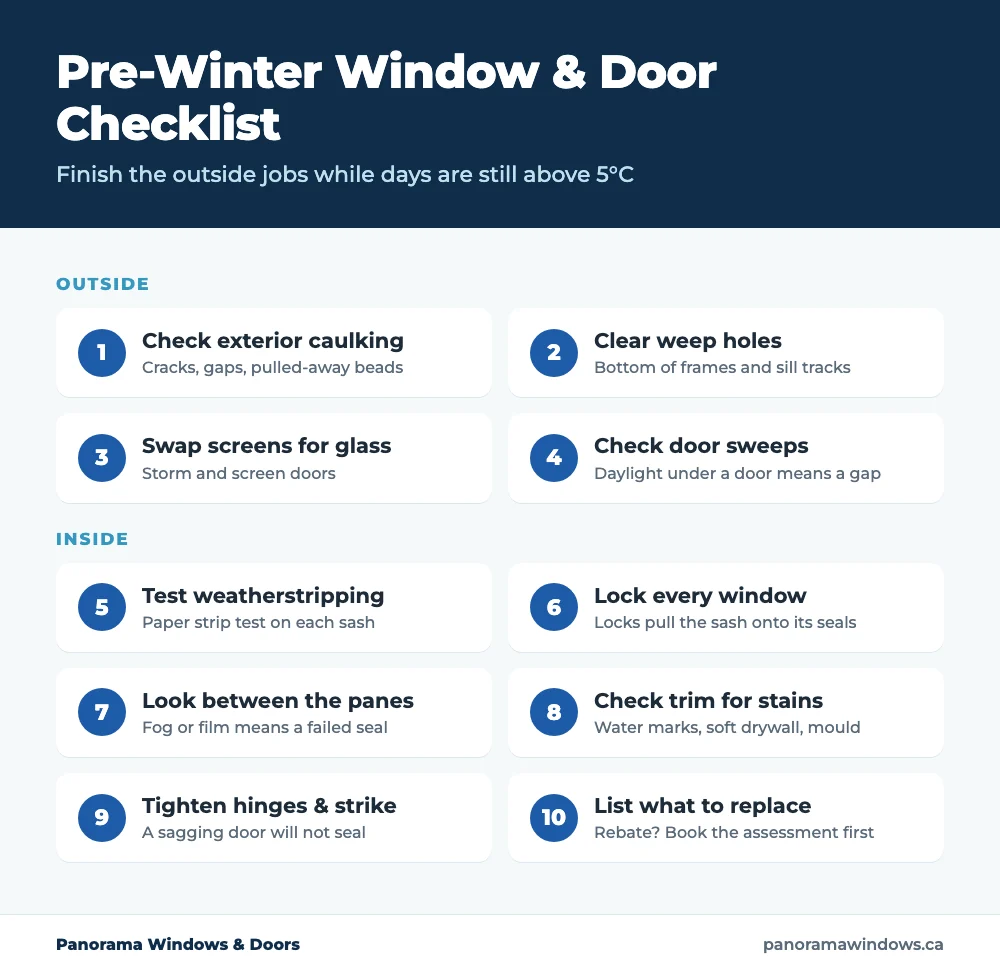
Outside Jobs: Do These First
1. Check the exterior caulking
Walk around the house and look at the bead of caulking where each window and door frame meets the siding or brick. You are looking for cracks, gaps, bead that has pulled away from one side, and spots that feel hard and brittle. Pay extra attention to the top corners and to the sill, where water collects. Small cracks can be cut out and resealed on a dry day. If the caulking is failing on most of a wall, or the brick moulding behind it is soft, have it looked at before you seal over the problem.
2. Clear the weep holes and sill tracks
Most vinyl windows and patio doors have small drain slots on the outside of the bottom frame, called weep holes. They let rain and melt water escape from the sill. When leaves, grit or spider webs block them, water sits in the track and can freeze there. Vacuum the tracks, then clear each weep hole with a soft brush or a pipe cleaner. Pour a little water into the track and watch it drain to be sure.
3. Swap screens for glass on storm and screen doors
If you have a storm door with interchangeable inserts, put the glass panel back in now and store the screen somewhere dry. Check that the closer still pulls the door shut and that the wind chain is attached. A storm door left with its screen in all winter lets snow blow straight onto your entry door.
4. Check door sweeps and thresholds
Close each exterior door and look at the bottom from the inside with the lights off. Daylight under the door means cold air is coming in. Many doors have an adjustable threshold that raises with a few screws, and a worn sweep can usually be replaced without taking the door off. Our guide to the signs your door needs replacing in Ontario covers what to look for when an adjustment no longer closes the gap.
Inside Jobs
5. Test the weatherstripping
Close a sheet of paper in each opening sash and door, then pull it out. If it slides out with no resistance, the seal at that spot is not touching. Try it in a few places on every side. Flattened, torn or missing weatherstripping is one of the most common causes of winter drafts, and on many windows it can be replaced. We go through the whole process in how to find and fix window and door drafts in an Ontario home.
6. Lock every window
This one sounds too simple to matter, but on casement and awning windows the lock is what pulls the sash tight against its seals. A window that is closed but not locked can leak air all winter. Go room by room and make sure every window closes fully and locks without force. A lock that will not engage often points to a sash that has dropped or a hinge that needs adjusting.
7. Look between the panes
Fog, haze or a white film between the two layers of glass means the sealed unit has failed and the insulating gas has leaked out. Wiping the glass will not help, because the moisture is inside the unit. A failed seal does not need an emergency fix, but it is worth noting for the list you build in step 10. Our article on common window problems in Ontario homes explains which faults can be repaired and which cannot.
8. Check the trim and walls for water stains
Look at the drywall and trim around each window and below each sill. Brown marks, peeling paint, soft drywall or mould spots tell you water has been getting in, either from outside or from condensation running off the glass. It helps to know which one you are dealing with before winter, and our answer on why moisture around windows in Ontario homes is not always a window problem walks through how to tell them apart.
9. Tighten hinges and adjust the strike plate
A door that sags on its hinges will rub at the top of the latch side and leave a gap at the bottom. Tighten the hinge screws first. If the screws spin, a longer screw into the framing usually fixes it. Then check that the latch catches cleanly in the strike plate without you having to push or lift the door.
10. Make a list of what to replace
By now you will know which openings are fine, which need a small repair and which are past fixing. Write it down with the room and the problem for each one. If you plan to replace windows or doors and want to use the Home Renovation Savings rebate, the program requires a home energy assessment before any work starts, so book that first. We explain the rules in our guide to Ontario window and door rebates in 2026.
Repair or Replace?
Most of what you find on a fall walk-around can be repaired: caulking, weatherstripping, sweeps, hinges and locks. Replacement starts to make sense when the problem is in the window or door itself rather than its seals. That usually means:
- fog or film between the panes on more than one window
- soft, rotting or warped frames or sashes
- sashes that will not stay up or will not lock, even after adjustment
- a door that is cracked, warped or lets light through after the sweep and threshold are adjusted
- frost forming on the frames themselves, not only on the glass
If several of those show up, it is worth getting a quote for window replacement in Ontario or door replacement in Ontario before the weather turns, so you can plan the work and the budget rather than react to a failure in January.
One More Thing Before the Cold: Indoor Humidity
Once the heating comes on, watch the inside of your windows on the first cold mornings. Condensation along the bottom of the glass usually means the air in the house is holding more moisture than the glass can handle at that temperature. Running bathroom and kitchen fans, opening blinds so warm air reaches the glass and lowering a humidifier setting all help. If ice has formed on your windows in past winters, our guide on how to stop ice buildup on windows during an Ontario winter goes into more detail.
Frequently Asked Questions
Can I caulk windows in October in Ontario?
Usually, yes. Most exterior sealants are rated for use above about 4 to 5°C on a dry surface, and many October days in Ontario are warmer than that. Work in the middle of a sunny day, keep the tube at room temperature beforehand and check the minimum temperature on the label.
Should I take the screens out of my windows for winter?
You can leave most window screens in place. Taking them out lets in more winter light, but it also exposes them to damage in storage. On storm and screen doors, swap the screen for the glass insert so the door can block wind and snow.
Is it too late to replace windows once it gets cold?
No. Windows and doors can be installed through the winter, one opening at a time, so each room is open to the weather only briefly. The main things to plan around are the weather on install day and, if you want the rebate, booking the energy assessment before any work starts.
How often should I do this check?
Once a year in the fall is enough for most homes, with a quick look at the weep holes and tracks again in spring after the snow melts.
Need a Second Opinion?
If your checklist turned up more than you want to tackle, we can take a look. Book a free in-home consultation anywhere we serve in Ontario and we will tell you which openings need a repair, which need replacing and which are fine for another winter.
Written by Alex Soroka, Senior Project Manager.