

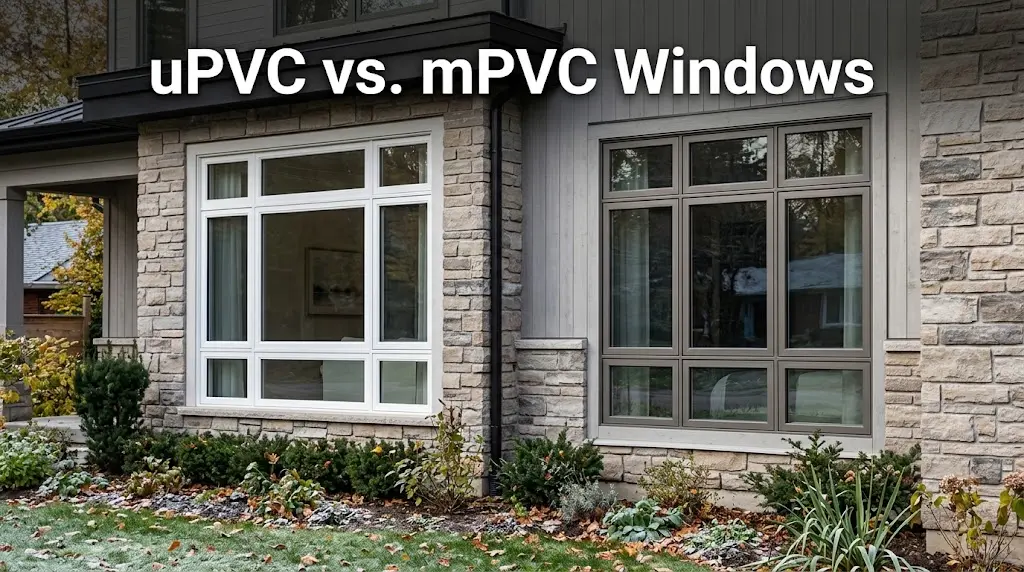
Choosing between uPVC vs. mPVC Windows can be confusing because both materials are used for energy-efficient vinyl window frames. For Ontario homeowners, the right choice depends on the complete window design, glass package, installation, climate exposure, warranty, cost, and local availability not the frame material alone.
uPVC vs. mPVC Windows: What Is the Difference?
The main difference is how the PVC frame is constructed. uPVC is rigid, unplasticized PVC commonly used for vinyl windows, while mPVC is microcellular PVC with a cellular or foamed structure and solid core.
The term mPVC can also cause confusion. In pipe manufacturing, MPVC can mean modified PVC, but the Ontario window market uses mPVC to mean microcellular PVC. The two terms describe different materials and should not be treated as interchangeable.
What Is uPVC?
uPVC, or PVC-U, is unplasticized polyvinyl chloride. It is a rigid PVC material widely used for window frames and is commonly called vinyl in the window industry. It’s what sits behind the vinyl windows we carry and behind most replacement windows sold in Ontario.
A uPVC window frame can contain multiple chambers, reinforced sections, fusion-welded corners, and other design features. Some products also use injected insulating foam inside hollow chambers.
This means that two windows described as “vinyl” can have different construction and performance characteristics. The difference between a foam-filled profile and a multi-chamber one is a bigger deal than most quotes let on, and it happens entirely inside the word “vinyl.”
uPVC vs. mPVC Windows: What Is mPVC?
mPVC means microcellular PVC. It uses a cellular PVC structure rather than the conventional hollow-chamber construction found in many vinyl window profiles.
In the Canadian market, the term is strongly associated with one trademarked product line, RevoCell®, launched in 2017 and sold through a single manufacturer’s dealer network. That matters practically: unlike vinyl, mPVC is not a category you can shop across several brands.
The distinction also matters technically, because mPVC is not simply another name for a standard hollow vinyl frame.
uPVC vs. mPVC Windows at a Glance
| Feature | uPVC Windows | mPVC Windows |
| Material | Rigid, unplasticized PVC | Microcellular PVC |
| Common industry name | Vinyl window | Cellular or microcellular PVC |
| Frame construction | Often hollow-chambered | Cellular/solid-core construction |
| Insulation | Depends on profile and glazing | Depends on cellular structure and complete design |
| Reinforcement | May include steel or other reinforcement | Construction varies by product |
| Availability | Broad Canadian market | More limited and product-specific |
| Cost | Wide range | Published Ontario pricing is limited |
| Long-term history | Established window material | Canadian market history dates to 2017 |
| Main buying consideration | Complete window design | Complete window design and product-specific evidence |
The table shows why material alone cannot determine window performance. The glass unit, Low-E coating, argon fill, spacer, seals, frame design, installation, and tested ratings also affect the finished window.
How Do uPVC and mPVC Windows Perform?
A window frame affects insulation, movement, strength, and weather resistance, but the complete assembly determines the final performance.
Energy Efficiency
Energy efficiency should be compared using the actual window’s U-factor and Energy Rating (ER) rather than assuming one PVC material is automatically more efficient.
A lower U-factor indicates less heat transfer through the window. ER combines several factors, including heat loss, solar heat gain, and air leakage.
ENERGY STAR Canada certification requires a U-factor of 1.22 W/m²·K or lower or an ER of 34 or higher either route qualifies. The Most Efficient tier sits higher, at a U-factor of 1.05 W/m²·K or lower or an ER of 40 or higher. Those are the thresholds the energy-efficient range we carry is quoted against.
One caution on ER specifically: because it credits solar gain, a window can post a strong number while losing more heat than a lower-gain unit with better insulation. We’ve written about where the Energy Rating figure misleads buyers and why U-factor deserves more weight on north elevations.
The important point is simple: compare the rating of the complete window configuration, not the insulation claim attached to the frame material.
A high-performance uPVC window can outperform a poorly specified mPVC window, just as a well-designed mPVC window can outperform a basic vinyl product.
Strength and Wind Performance
Ontario windows face wind, rain, snow, temperature changes, and repeated seasonal movement. The frame must therefore do more than insulate.
The North American Fenestration Standard (NAFS) establishes requirements related to air leakage, water resistance, wind resistance, forced-entry resistance, and operation. The Canadian Supplement, CSA A440S1, is part of the Canadian testing and labelling system.
When comparing quotes, ask for the window’s NAFS performance class and design pressure rather than accepting a general statement such as “stronger frame.”
Air and Water Resistance
A window can lose efficiency if air leaks through the assembly or if water penetrates around the frame.
Look for documented testing rather than general material claims. A complete window’s performance depends on the frame, sash, seals, corners, drainage paths, glass unit, hardware, and installation.
For Ontario homes exposed to wind-driven rain, this distinction matters. A better frame material does not compensate for poor installation or weak sealing, which is why how the window is fitted in Barrie belongs in the comparison alongside the frame spec.
Are uPVC or mPVC Windows Better for Ontario Winters?
Ontario’s climate creates several conditions that matter when selecting replacement windows: freezing temperatures, freeze-thaw cycles, snow, wind-driven rain, and significant seasonal temperature changes.
The province spans roughly −30°C to above 30°C across the year, and Northern Ontario asks more of a window than the lakeshore does. A specification written for Toronto is not automatically right for Sudbury.
Freeze-Thaw Cycles and Frame Movement
PVC frames expand and contract as temperatures change. Rigid vinyl has measurable thermal expansion, so a long frame can move between winter and summer.
Dark-coloured profiles can absorb more solar heat, which can increase temperature differences between the frame and surrounding materials.
Cellular PVC also expands and contracts. Claims that a particular mPVC construction moves less than conventional vinyl should be evaluated against product-specific testing rather than treated as a universal property of all mPVC windows.
For an Ontario installation, the better question is:
How does this specific window accommodate thermal movement, and what testing supports the manufacturer’s claim?
Where the climate genuinely does change the spec is the glass. A third pane through an Ontario winter moves the needle further than any argument about frame chemistry.
Does Frame Material Affect Condensation?
Yes, but frame material is only one part of the equation.
A frame that conducts more heat can create colder interior surfaces. If indoor humidity is high and the interior surface reaches the dew point, condensation can form.
However, condensation also depends on:
- Indoor humidity
- Outdoor temperature
- Glass performance
- Spacer design
- Frame design
- Air leakage
- Window installation
- Room ventilation
Therefore, replacing a window with mPVC does not automatically eliminate condensation.
For Ontario homes, controlling indoor humidity and comparing the complete window’s condensation performance is more useful than focusing only on whether the frame is uPVC or mPVC. Our guide to water collecting around window frames covers the diagnosis when it keeps coming back.
Which Is Better for Noise Reduction?
Noise control depends heavily on the glass configuration and complete window assembly.
Ask about the window’s STC and OITC ratings if exterior noise is an important concern. The frame can influence sound performance, but the glass, air spaces, laminated layers, seals, and overall construction also contribute.
A homeowner living beside a busy road should compare the tested acoustic rating of two complete window configurations rather than choosing on frame material.
How Do uPVC and mPVC Windows Handle Summer Heat?
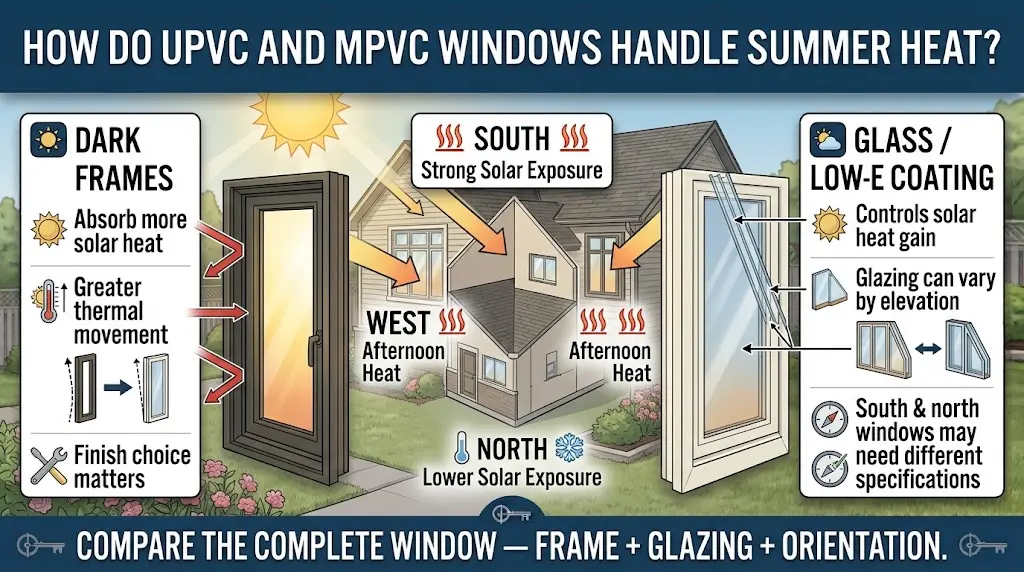
Ontario’s summers can expose windows to strong solar radiation, particularly on south- and west-facing elevations.
Dark frames can absorb more solar heat than lighter colours. The frame’s thermal movement and the window’s solar heat gain characteristics therefore deserve attention when choosing a darker finish.
The correct solar heat gain depends partly on the home’s orientation and the window’s glazing package. A south-facing window and a north-facing window do not necessarily need the same glass specification. That is set by the Low-E coating, not by the frame, and it can vary elevation by elevation within a single order.
This is another reason to compare the complete window rather than the frame material in isolation.
What About Colours and Appearance?
uPVC windows are available in a broad range of colours and finishes, depending on the manufacturer and profile.
mPVC products can also offer different colour and finish options, but availability is product-specific.
If appearance is important, ask whether the colour is:
- Painted
- Laminated
- Capped through co-extrusion
- Integrated into the material
- Covered by the manufacturer’s warranty
Do not assume that a colour or finish offered on one frame material is available on every window system.
Which Material Lasts Longer?
Both materials require a closer look than a simple lifespan number.
uPVC has a long history in window manufacturing, giving homeowners a substantial installed base and an established replacement ecosystem. It is also the material most Ontario homeowners are actually choosing between when they compare vinyl against wood frames.
mPVC has a shorter Canadian commercial history, dating to 2017. That does not establish a shorter service life. It means there is less Canadian field history from which to assess very long-term performance.
When evaluating durability, ask about:
- Frame and sash construction
- Corner joints
- Hardware
- Seal replacement
- Glass-unit warranty
- Colour and finish warranty
- Installation coverage
- Availability of replacement components
A warranty is useful, but the warranty terms are more important than the headline number.
How Much Do uPVC and mPVC Windows Cost in Ontario?
There is no reliable universal price difference between uPVC and mPVC windows.
Ontario vinyl windows typically run $600 to $1,200 installed per window for standard units, with premium and custom configurations climbing well beyond that. Published mPVC pricing is limited enough that no comparable range can be stated honestly.
Dealer claims that a particular mPVC product costs about the same as quality hollow-chamber PVC should be treated as a product-specific claim rather than a market-wide pricing rule.
Your final quote can change based on:
- Window size
- Window style
- Double- or triple-pane glass
- Low-E coating
- Gas fill
- Spacer system
- Frame colour
- Reinforcement
- Brickmould
- Installation method
- Interior and exterior finishing
- Number of windows
- Warranty coverage
For that reason, compare complete quotes with matching specifications. Our breakdown of what drives a replacement quote covers which of those variables move the number most.
A $700 uPVC window and a $1,100 mPVC window are not meaningful comparisons if the glass, hardware, installation, and warranty are different.
Is mPVC Available Everywhere in Ontario?
No. Availability depends on the manufacturer and dealer network, which is concentrated in parts of Southern Ontario and Ottawa rather than spread across the province.
This matters if you live outside major markets.
Before choosing a less common window system, confirm:
- Who manufactures the window?
- Who installs it in your area?
- Where is the product manufactured?
- Who handles warranty service?
- Are replacement parts locally available?
- Can the company service the window several years after installation?
Local support can matter as much as the material itself. A frame you cannot get serviced in Barrie or Sudbury in year eight is a worse buy than a well-specified vinyl window you can.
uPVC vs. mPVC Windows: Which One Fits Your Home?
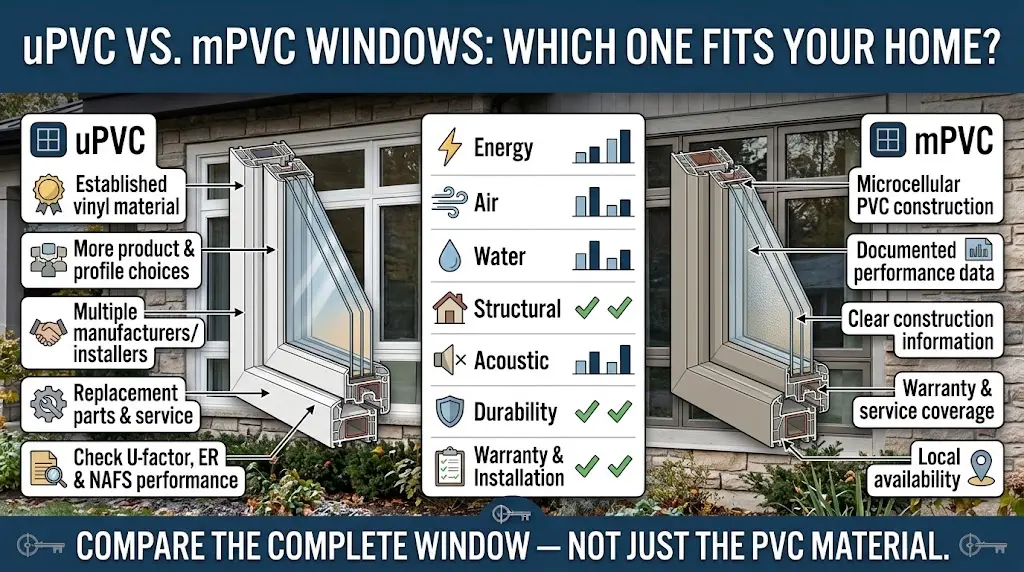
There is no material-only answer that applies to every Ontario home.
Choose uPVC if:
- You want a widely established vinyl window material.
- You have several manufacturers and installers to compare.
- You want more profile and product choices.
- Your preferred window already provides the U-factor, ER, and NAFS performance you need.
- You want established access to replacement parts and service.
Consider mPVC if:
- You specifically want a microcellular PVC construction.
- The available product provides documented performance data.
- The dealer can explain its construction clearly.
- The quoted price fits your budget.
- Warranty and service coverage are satisfactory.
- The product is available and serviceable in your Ontario location.
The strongest comparison is not “Which PVC is better?”
It is:
Which complete window gives your home the required energy, air, water, structural, acoustic, durability, warranty, and installation performance at an acceptable cost?
That’s the question our replacement work in Barrie is priced and specified against U-factor and ER for your exact configuration, elevation by elevation, in writing.
10 Questions to Ask Your Ontario Window Dealer
Before signing a contract, ask these questions:
- What is the exact window model?
- Is the frame uPVC, foam-filled uPVC, or mPVC?
- What are the U-factor and ER for my exact configuration?
- Is the product ENERGY STAR certified or listed?
- What is the NAFS performance class?
- What are the air and water performance ratings?
- What glass, Low-E coating, gas fill, and spacer are included?
- How does the frame handle thermal expansion and contraction?
- What does the warranty cover, and for how long?
- Who provides warranty service if a component fails?
These questions turn a material comparison into a complete product comparison. For the wider vetting checklist insurance, itemized quotes, installer training, we’ve covered how to choose a window company in Ontario separately.
Frequently Asked Questions
Is mPVC the same as uPVC?
No. uPVC is rigid, unplasticized PVC, while mPVC refers to microcellular PVC with a cellular structure. In the Ontario window market, mPVC is associated with specific microcellular window products.
Is mPVC the same as modified PVC?
No. mPVC in Ontario window discussions means microcellular PVC. MPVC can also refer to modified PVC in pipe applications, which is a different material.
Are vinyl windows the same as uPVC windows?
In the window industry, “vinyl window” commonly refers to a window made with rigid PVC/uPVC profiles. The terms are frequently used together by Canadian and Ontario window sellers.
Is mPVC more energy efficient than uPVC?
Not automatically. The energy performance of a window depends on the complete assembly, including the frame, glass, Low-E coating, gas fill, spacer, seals, and other design elements.
Compare the U-factor and ER of the exact window configuration rather than relying on the material name.
Are mPVC windows stronger than uPVC windows?
Strength depends on the specific profile, wall thickness, reinforcement, geometry, hardware, and tested performance.
Ask for the window’s NAFS classification and supporting test information instead of assuming that one PVC construction is stronger in every application.
Do mPVC windows expand and contract?
Yes. Cellular PVC still responds to temperature changes. The amount of movement depends on the product’s construction, dimensions, temperature, colour, and installation details.
Are mPVC windows more expensive?
No universal Ontario price difference has been established. Published mPVC prices are limited, while vinyl window prices vary substantially based on size, glazing, installation, and specifications.
Compare complete quotes with equivalent specifications.
Are mPVC windows available throughout Ontario?
No. Availability depends on the manufacturer and dealer network, with stronger coverage in Southern Ontario and Ottawa than across the province.
Final Takeaway
The right choice between uPVC vs. mPVC Windows depends on the complete window rather than the PVC label.
uPVC offers an established window material with broad availability and many profile options. mPVC provides a different cellular frame construction that has been commercially available in Canada since 2017, but its long-term Canadian field history is shorter.
For an Ontario home, compare the U-factor, ER, NAFS rating, glass package, air and water performance, thermal movement, warranty, installation quality, price, and local service support before making a decision.
The best window for your home is the one whose documented specifications match your climate, building, budget, and long-term service needs, not simply the one with the more advanced-sounding frame material.
Book a free in-home consultation and we’ll put the U-factor, ER and NAFS class for your exact configuration on the quote, so you can compare like with like. The reviews on our Google profile are worth ten minutes first, they’re the version we don’t get to edit.
Written by Alex Soroka, Senior Project Manager.