

Sudbury’s climate pushes replacement windows toward triple-pane, low-E, argon-filled units with warm-edge spacers and a U-factor at or below 1.05 W/m²K. The city records roughly 100 days a year when the temperature never climbs above 0 °C and averages 265 cm of snow, which puts far more thermal stress on glass than any specification written for Southern Ontario anticipates.
That gap between provincial averages and northern reality drives every decision below.
The Four Climate Numbers That Decide Your Window Spec
Four measurements from Sudbury’s climate record set the performance floor for any window you install here.
| Measurement | Sudbury value | What it forces |
| January mean temperature | −12.6 °C | Continuous heat loss through glass for four months |
| Typical coldest nights | Around −30 °C | Condensation and frost on underperforming glazing |
| Days never above 0 °C | About 100 per year | Sustained load, not occasional cold snaps |
| Annual snowfall | 265 cm | Meltwater, ice damming and sill drainage stress |
The record low sits at −39.3 °C, set in January 1982. Sudbury also logs about three nights a year below −30 °C and 178 days a year when the minimum reaches 0 °C or lower.
Those figures matter because window performance is rated at a single set of test conditions. A unit that performs adequately at −5 °C in Windsor behaves differently at −30 °C in Minnow Lake.
Why Sudbury Sits in SB-12 Climate Zone 2
Sudbury falls in Zone 2 of Ontario Building Code Supplementary Standard SB-12, the zone for locations with 5,000 or more heating degree days below 18 °C.
SB-12 splits Ontario into two zones only. Zone 1 covers locations under 5,000 heating degree days; Zone 2 covers everything at or above that threshold. The dividing line runs roughly from south of Sault Ste. Marie eastward, which places Sudbury firmly on the northern side. Degree-day values for individual Ontario municipalities appear in Supplementary Standard SB-1.
Zone 2 compliance packages demand better envelope performance than Zone 1 packages. Two consequences follow for anyone replacing windows as part of a larger renovation:
- Glazing area triggers stricter requirements. Where windows, skylights, sidelights and glazed doors exceed 17% of gross wall area, SB-12 requires higher-efficiency glazing.
- Heavy glazing removes the simple path. Where that ratio exceeds 22%, the prescriptive compliance option no longer applies and the project moves to performance modelling.
Straight window replacement in existing openings does not usually trigger SB-12. Additions, new openings and full renovations do.
The ENERGY STAR Rule Most Ontario Window Sites Still Get Wrong
ENERGY STAR Canada has used a single national zone since January 1, 2020. Ontario window pages still advertising “Zone 2” or “Zone 3” thresholds are quoting a system that Natural Resources Canada retired six years ago.
The current criteria are simple:
- ENERGY STAR certified: U-factor of 1.22 W/m²K or lower, or an Energy Rating of 34 or higher
- ENERGY STAR Most Efficient: U-factor of 1.05 W/m²K or lower, or an Energy Rating of 40 or higher
Two metrics, one threshold each, applied identically from Windsor to Moosonee. Every unit in the energy-efficient range we carry is quoted against those two numbers rather than a zone label.
Why Sudbury Buyers Should Weight U-Factor Over Energy Rating
The Energy Rating combines three inputs: heat loss, passive solar heat gain and air leakage. A window with generous solar gain can post a strong ER while losing more heat than a lower-SHGC unit with better insulation.
That trade-off works in a sunny climate. Sudbury delivers roughly 3 hours of sunshine per day in January, or about a third of available daylight across a 9-hour day. Solar credit that a window earns on paper does not arrive through a north-facing opening under overcast January skies.
Ask for the U-factor on every quote. Treat the ER as secondary except on south-facing glass. We’ve written more on where the Energy Rating number misleads buyers.
Double-Pane Versus Triple-Pane at −30 °C
Triple-pane glazing is the correct default in Sudbury, and it costs roughly $150 to $300 more per window than double-pane in current Ontario pricing.
Triple-pane units reduce heat transfer by about 15% to 25% compared with double-pane units of similar build. In Southern Ontario that margin is arguable. In a climate with 100 sub-freezing days, the margin compounds across the entire heating season, the case we make in full for a third pane through an Ontario winter.
The stronger argument is not energy. It is surface temperature.
Condensation: The Sudbury Symptom That Is Not Always the Window’s Fault
Condensation on the room side of your glass indicates indoor humidity exceeding what your glass surface temperature can carry. The window is reporting a problem rather than causing one.
The thresholds are measurable:
- Double-pane glass begins collecting condensation at roughly 25% to 40% indoor relative humidity in cold weather.
- Triple-pane glass tolerates roughly 30% to 50% before condensation forms.
- ENERGY STAR guidance for cold climates recommends holding indoor humidity between 30% and 40%.
- On the coldest Sudbury nights, near −30 °C, indoor humidity generally needs to drop to 20% to 25% to keep glass clear.
Triple glazing widens that operating window. The third pane keeps the interior glass surface warmer, so a household can run 40% humidity in February without water pooling on the sills. If you’re already seeing it, our guide to why water shows up on your sills walks through the diagnosis.
Fog trapped between the panes is a different failure entirely. Sealed-unit fogging means the insulating glass seal has failed and the gas fill has escaped, which no humidity adjustment repairs. Replace the sealed unit or the window.
Frames, Spacers and Freeze-Thaw Cycling
Warm-edge spacers and vinyl frames outperform aluminum-spacer, aluminum-frame units in Sudbury, because the perimeter of the glass is where cold-climate windows fail first.
Three components determine whether a window survives northern cycling:
- Spacer. Aluminum spacers conduct cold straight to the glass edge, producing the frost line homeowners see along the bottom rail. Warm-edge spacers made from foam, stainless steel or composite raise that edge temperature. It’s the single biggest factor in stopping ice building up along the bottom of the glass.
- Gas fill. Argon fills the standard cavity. Krypton performs better in narrow cavities, which matters in triple-pane units where the sash depth limits each gap.
- Frame material. Multi-chamber vinyl frames resist the expansion and contraction that Sudbury’s freeze-thaw swings impose, and the chambered profile does insulating work an aluminum frame cannot. Ask how many chambers a quoted profile carries, it varies more between manufacturers than the brochures suggest.
Sudbury crosses the freezing point repeatedly through March and April, when daytime melt and overnight refreeze work every joint in the assembly.
Solar Orientation in a Heating-Dominated Climate
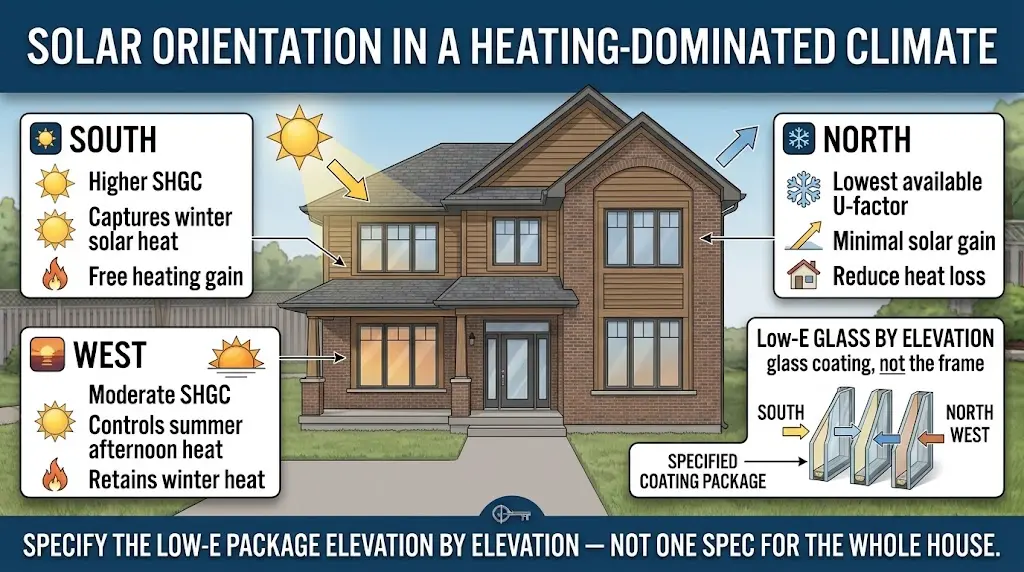
South-facing windows in Sudbury should carry a higher solar heat gain coefficient than north-facing windows, because the heating season dwarfs the cooling season here.
Sudbury’s frost-free period runs 136 days on average, with the last spring frost around May 17 and the first fall frost around October 1. Cooling load occupies a narrow window; heating load occupies most of the calendar.
Specify accordingly:
- South elevations: higher SHGC, capturing free winter heat through the shortest months.
- North elevations: lowest available U-factor, since no meaningful solar gain arrives to offset losses.
- West elevations: moderate SHGC, balancing July afternoon heat against January heat retention.
Orientation is set by the coating, not the frame, which is why the Low-E package should be specified elevation by elevation rather than ordered as one spec for the whole house. Most manufacturers will build different glass packages within one order. Ask before the quote is finalized rather than after.
Basement Egress Windows Under the 2024 OBC
Every floor level containing a bedroom needs at least one window that opens from inside without tools and provides an unobstructed opening of at least 0.35 m² with no dimension under 380 mm, unless a door on that level opens directly to the exterior.
Ontario Building Code Article 9.9.10.1 sets those requirements, and the 2024 edition (O. Reg. 163/24) took effect January 1, 2025. Four additional conditions apply:
- Sill height stays at or below 1,000 mm above the floor, except in basements.
- A window opening into a window well needs 550 mm of clearance in front of it.
- A sash swinging toward the well must not reduce that clearance enough to restrict escape.
- A cover over the well must open from inside without keys, tools or special knowledge.
Snow load makes clause 2 and clause 4 practical concerns rather than paperwork in Sudbury. A window well that fills with 265 cm of seasonal snowfall provides no escape route in February.
Bringing an undersized basement opening up to egress means enlarging the framing, which is a different job from swapping a basement window into its existing opening.
Do You Need a Permit in Greater Sudbury?
Greater Sudbury lists the addition or alteration of windows and doors among the exterior renovations that require a building permit. That framing is stricter than several southern Ontario municipalities, which exempt like-for-like swaps in unchanged openings.
Confirm your specific scope before ordering. The City publishes a project-by-project list of what does and does not require a permit, and it states plainly that the list is not exhaustive.
Where to check:
- Building Services: 705-674-4455, extension 4278
- General enquiries: dial 311 locally, or 705-671-2489 long distance
- Applications: submitted online through PRONTO, the City’s permit portal
- In person: 200 Brady Street, Sudbury, ON P3A 5P3
Enlarging an opening always triggers a permit, because cutting the framing changes the header and the load path above it. Converting a basement window to code-compliant egress falls into that category.
Permit handling is part of how we work across Greater Sudbury: drawings where the framing changes, and the closing inspection booked before we hand the house back.
What Window Replacement Costs Around Sudbury
Replacement windows in Ontario run $600 to $1,200 per window installed for standard units. National figures stretch to $2,000 per window, with premium and custom units reaching $3,000 to $4,000.
Cost drivers worth pricing separately:
- Triple-pane upgrade: adds roughly $150 to $300 per window over double-pane.
- Full-frame versus insert: insert replacement into a sound existing frame saves roughly $200 to $400 per window.
- Whole-home projects: ten to fifteen windows typically total $8,000 to $25,000.
Collect three written quotes on identical scope. Northern logistics and a smaller installer pool can move Sudbury pricing away from Southern Ontario benchmarks in either direction. Our breakdown of what drives a replacement quote covers the variables in more detail.
What You Can Actually Claim in 2026
Federal support has largely wound down, and several guides still describe programs that closed years ago.
- Canada Greener Homes Grant: closed to new applications in February 2024. December 31, 2025 was only the final date for existing applicants to submit documents. It is not open to anyone starting now.
- Canada Greener Homes Loan: interest-free retrofit loans closed to new applications on October 1, 2025.
- Canada Greener Homes Affordability Program: announced for low-to-median-income households. Check current status and eligibility directly with Natural Resources Canada.
The live option for most Sudbury homeowners is provincial. Ontario’s Home Renovation Savings Program pays $100 per eligible window or door rough opening for ENERGY STAR certified products, with a three-opening minimum, ten windows returns $1,000. Our current rebate terms page tracks what’s open, and program windows have moved more than once, so confirm before you build it into a budget.
Scheduling the Work Around a Sudbury Winter
Full-frame window replacement belongs in the window between the last spring frost and the first fall frost, which averages 136 days in Sudbury from roughly May 17 to October 1.
Sealants, foams and flashing tapes carry minimum application temperatures. Installing below those temperatures compromises the air seal, which is the component that determines whether the new window actually performs at its rated U-factor.
Insert replacements tolerate shoulder-season work better than full-frame tear-outs, because the wall stays closed. That’s a scheduling question worth raising early when you book installation work in Sudbury, since the northern season is shorter than the provincial guidance assumes.
Book emergency winter replacements, but plan discretionary projects for the warm months. There’s more on picking the right month for the job if timing is flexible.
Frequently Asked Questions
Are triple-pane windows worth it in Sudbury?
Triple-pane windows are worth the roughly $150 to $300 premium per window in Sudbury, because the city records about 100 days a year that never rise above freezing and triple glazing keeps interior glass warm enough to prevent condensation at normal indoor humidity.
What U-factor should I specify for a Sudbury home?
Specify 1.05 W/m²K or lower, which is the ENERGY STAR Most Efficient threshold. ENERGY STAR certification alone requires only 1.22 W/m²K.
Which ENERGY STAR zone is Sudbury in?
Sudbury sits in no zone. Natural Resources Canada consolidated the Canadian zones into a single national standard on January 1, 2020.
Why do my new windows still get condensation?
Indoor humidity above what the glass surface temperature can carry causes room-side condensation. At −30 °C outside, indoor relative humidity generally needs to sit between 20% and 25% to keep glass clear.
Do I need a permit to replace windows in Greater Sudbury?
Greater Sudbury includes window and door alterations among the exterior work requiring a permit. Confirm your scope with Building Services at 705-674-4455 extension 4278 before ordering.
What size does a basement egress window need to be?
An egress window needs an unobstructed opening of at least 0.35 m² with no dimension under 380 mm, and it must open from inside without tools.
What to Confirm Before You Sign
Five specifications separate a window that performs in Sudbury from one that merely passes:
- U-factor at or below 1.05 W/m²K, stated on the quote rather than implied by a brand name.
- Triple-pane glazing with low-E coating and argon or krypton fill.
- Warm-edge spacer, specified by material rather than by marketing name.
- Glass package matched to orientation, with higher SHGC facing south.
- Permit status confirmed with Greater Sudbury Building Services before the order goes in.
Sudbury does not reward a window that was specified for Toronto. Four months of continuous sub-freezing load finds every shortcut in the assembly.
Book a free in-home consultation and we’ll put all five on the quote in writing, elevation by elevation.
Building Code references reflect the 2024 Ontario Building Code (O. Reg. 163/24), in effect since January 1, 2025. Climate figures come from Environment Canada station records for Sudbury. Confirm permit requirements for your project with the City of Greater Sudbury Building Services at 705-674-4455 extension 4278, and confirm current incentive programs with Natural Resources Canada, before ordering.
Written by Alex Soroka, Senior Project Manager.