

A draft is easy to feel and surprisingly hard to find. You notice cold air near a window or a chill along the floor by the front door, but the leak itself can be at the sash, behind the trim, under the door or somewhere else entirely. Fixing the wrong spot wastes a weekend and a tube of caulking.
This guide shows you how to find window and door drafts in an Ontario home before winter, which fixes you can do yourself, and how to tell when the draft is coming from a window or door that has reached the end of its life.
Why Drafts Cost More Than You Think
Natural Resources Canada's home energy guide, Keeping the Heat In, describes air sealing as the single most important retrofit, the one to consider first in any upgrade, because leaks carry warm air out of the house on every cold day. The same guide notes that windows, doors and skylights can account for up to 35 percent of a home's heat loss. Drafts also make a room feel colder than the thermostat says, which leads people to turn the heat up and pay for it twice.
Where Drafts Usually Come From
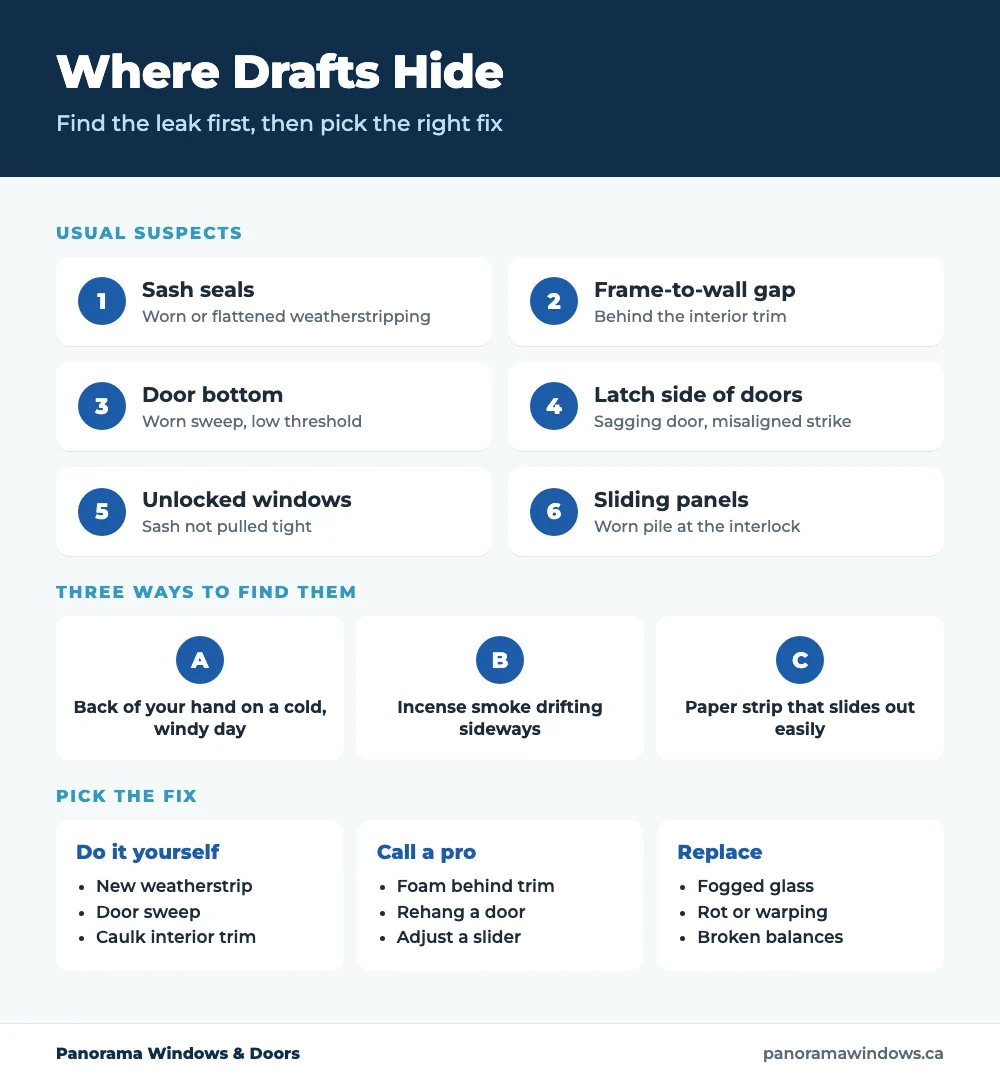
In most homes, the leaks are in the same few places:
- Sash seals. Weatherstripping that is flattened, torn, shrunk or missing.
- The gap between the frame and the wall. Hidden behind the interior trim, often filled with fibreglass that has settled or nothing at all.
- The bottom of exterior doors. A worn sweep or a threshold set too low.
- The latch side of a door. A door that has dropped on its hinges no longer presses evenly on the weatherstrip.
- Windows that are closed but not locked. On casement and awning windows, the lock is what pulls the sash onto its seals.
- Sliding windows and patio doors. Worn pile weatherstripping where the panels overlap.
How to Find a Draft: Three Simple Tests
The back of your hand
Wait for a cold, windy day, when the difference between inside and outside air is largest. Turn off the furnace fan and any bathroom or kitchen fans so they do not move air around, then slowly run the back of your hand along the edges of each sash, the trim and the door frame. The back of the hand is more sensitive to temperature than the palm.
The incense test
Light an incense stick and hold it a few centimetres from the same edges. Where the smoke drifts sideways or gets pulled into a gap, you have a leak. Keep the stick away from curtains and blinds, and never leave it burning unattended.
The paper strip test
Close a strip of paper in the sash or door and pull it out. Where it slides out easily, the weatherstrip is not making contact. Test several points along every side, because a seal can be tight at the middle and open at a corner.
For a full picture, an energy advisor can run a blower door test as part of a home energy evaluation. It depressurizes the house so leaks are easy to find, and it is part of the assessment you would need anyway if you plan to use the Home Renovation Savings rebate for windows and doors in Ontario.
Fixes You Can Do Yourself
Replace worn weatherstripping
Many windows use weatherstripping that presses or slides into a groove in the frame or sash. Pull a short piece and take it to the store, or contact the manufacturer, so you get the same profile. Self-adhesive foam is fine for an old wooden door frame, but it rarely lasts on a vinyl window, where the original seal type works better.
Adjust or replace the door sweep
Most door sweeps slide into a channel at the bottom of the door or screw onto the inside face. If yours is torn or stiff, replace it. If the door has an adjustable threshold, turn the screws to raise it a little until the sweep touches along its full length without dragging.
Caulk the interior trim
Where you feel air coming from the joint between the trim and the wall, or between the trim and the frame, a bead of paintable interior caulking closes it. This does not fix the gap behind the trim, but it stops the air reaching the room.
Use window film as a stopgap
Shrink-film kits fitted to the inside of the trim can block drafts from an old window for one season. They are a temporary measure, and they make it hard to open the window in an emergency, so do not use them on a bedroom window you might need to exit through.
Fixes Best Left to a Professional
- Insulating behind the trim. The gap between the frame and the wall should be sealed with a low-expansion foam made for windows and doors. Ordinary expanding foam can bow a frame so it no longer opens. This means removing and refitting the trim.
- Rehanging a door. If tightening the hinges does not stop a door from sagging, the frame may be out of square or the hinges may need shimming.
- Adjusting sliders and sashes. Rollers, balances and hinges can often be adjusted or replaced, but parts are specific to each manufacturer.
Installation quality matters here too. A window that was poorly sealed into the wall will leak no matter how good the window is, which is why we wrote a separate guide on energy-efficient window installation for Ontario homes.
When the Draft Means Replacement
Weatherstripping and caulking can only seal a window or door that still closes properly. Replacement is the better choice when you find:
- sashes that are warped, rotting or cracked, so the seal has nothing solid to press against
- double-hung or single-hung windows with broken balances that will not stay closed tightly
- old aluminum or single-glazed windows that are cold to the touch even when sealed
- fog between the panes, which means the sealed glass unit has failed
- a door that is warped or split, or lets light through after the sweep and threshold are adjusted
If you are comparing replacement windows, look past the single number on the sticker. Our article on reading window energy ratings for an Ontario home explains what the ratings mean, and our energy-efficient windows for Ontario homes page shows the options we install. For doors, our steel entry doors in Ontario and fiberglass entry doors in Ontario pages compare the two most common insulated choices.
Started with the fall checklist? This draft hunt fits in as steps 5 and 6 of our fall window and door checklist for Ontario homes. If the draft is coming from a sliding patio door, see our guide to winterizing a sliding patio door in Ontario.
Frequently Asked Questions
Is it normal for new windows to feel cold?
The glass on a well-sealed window will still feel cooler than the wall on a very cold day, because glass does not insulate as well as an insulated wall. What should not happen is moving air. If you feel a draft rather than a cool surface, the window or its installation needs checking.
Can I fix drafty windows without replacing them?
Often, yes. New weatherstripping, locking the sash properly, caulking the interior trim and sealing behind the trim fix many drafts. Replacement makes sense when the window itself is damaged or the glass seal has failed.
Why is there a draft at the bottom of my front door?
Usually because the door sweep is worn or the threshold is set too low. Check for daylight under the door, then adjust the threshold or replace the sweep. If the door has dropped on its hinges, tighten those first.
Does closing the blinds stop drafts?
Blinds and curtains reduce the chill you feel near the glass but do not stop air leaking in. In winter, open them during the day so warm room air can reach the glass, which also helps limit condensation.
Still Feeling the Cold?
If you have sealed what you can and the room is still drafty, book a free in-home consultation anywhere we serve in Ontario. We will show you where the air is coming in and whether it is a repair or a replacement.
Written by Alex Soroka, Senior Project Manager.