

Most Ontario homeowners spend weeks obsessing over glass types, frame materials, and energy ratings. They finally find the perfect product, but then they hand the project off to whoever offers the lowest quote and hope for the best.
That is exactly where most home upgrades quietly fail.
Even the highest-rated windows will underperform if they aren’t fitted with precision.
In a climate like ours, getting the product right is only half the battle. The rest is won during the install. In this blog, we’re sharing professional tips for energy-efficient window installation to ensure your investment pays off for the next thirty years.
So, before you tear out your old frames or sign a contract, let’s look at the make-or-break details that keep the Ontario cold out and your hard-earned money in.
What Is an Energy-Efficient Window?
At its simplest, an energy-efficient window is a high-performance system designed to stop heat from escaping or entering your home.
Unlike traditional windows that rely on a single pane of glass, these units are engineered to act as a thermal barrier between your living space and the Ontario climate.
To earn this title, the window must combine several key technologies:
Multiple Glazing: Two or three panes of glass that create insulating air pockets.
Low-E Coatings: Invisible metallic layers that reflect heat back to its source.
Gas Fills: Denser-than-air gases (like Argon) sealed between panes to slow down heat transfer.
Insulated Frames: Frames built from non-conductive materials that prevent cold from seeping through the edges.
Essentially, it is a window that works 24/7 to stabilize your indoor temperature, which is the primary driver behind all the benefits of energy-efficient windows.
However, as we are only focusing on tips for energy-efficient window installation, let’s learn why properly installing energy-efficient windows is important.
You can read this guide on the benefits of energy-efficient windows for a better in-depth knowledge.
Why Does Proper Installation Matter for Energy Efficiency?
A homeowner invests in premium triple-pane windows, yet months later, they’re still fighting drafts with plastic film or towels. This usually happens because the installation was treated as an afterthought.
You can’t simply buy efficiency because you have to build it into the wall.
In Ontario, our homes endure a brutal cycle, from humid 35°C summers to -25°C winter nights. This puts the window-to-wall connection under extreme thermal stress. If that interface isn’t engineered with care, even the most expensive glass becomes little more than a wall ornament.
To help you protect your investment, the most important factor you need to know is the proper way of energy-efficient window installation. Here are some reasons why proper installation matters the most for energy-efficient windows:
1) Eliminating Thermal Leaks and the Chimney Effect
The Department of Energy reports that windows account for 25% to 30% of a home’s total thermal loss. However, those figures assume a perfect seal. If an installer rushes the job, they often leave microscopic gaps between the window frame and your home’s rough opening.
While these gaps are invisible to the naked eye, the Ontario wind will find them instantly. This creates a chimney effect, where your expensive, heated air is vacuumed out and replaced by a steady cold draft.
It is a critical reminder that no amount of high-tech Low-E coating can compensate for a physical hole in the side of your house. Precise insulation at the perimeter is what actually locks in the performance you paid for.
2. The Nightmare of Water Ingress and Structural Rot
We talk a lot about heat, but in Ontario, moisture is the real slow killer of homes. If the flashing isn’t layered like shingles on a roof, or if the caulking isn’t industrial grade, water will find its way behind your siding.
The scary part is you won’t know it’s happening for years. It stays hidden behind the drywall, quietly rotting your studs and feeding mould. By the time you notice a soft spot in the wall or a musty smell, you’re looking at a structural repair that costs far more than the windows themselves.
3. Protecting Your Financial Safety Net (The Warranty)
There’s a technical side to this that most people don’t realize until it’s too late. Manufacturers are very specific about how their products must be supported and sealed. If a general handyman uses the wrong expanding foam, it can bow the vinyl and break the glass seal.
If that happens, the manufacturer will walk away from the claim faster than you can imagine. A professional install isn’t just about the seal. It’s about making sure your 20-year warranty actually stays valid for 20 years.
The window is just a component. The installation is the actual service that makes your home livable. You are paying for a result, not just a delivery of glass and plastic.
If you treat the labour as a commodity to be bought at the lowest price, you’re likely leaving a huge chunk of your energy savings on the table before the crew even leaves the driveway.
It’s a lot to take in, and it’s okay to feel a bit protective of your investment. One of the best ways to ensure you’re on the right track is to look at the window replacement mistakes others have made, so you can spot a red flag before a single nail is driven into your home.
So, if the importance of correctly installing an energy-efficient window is clear to you, we should next move on to the installation guide.
10 Tips for Energy-Efficient Window Installation
You could spend thousands on high-tech glass, but if it isn’t tucked into your wall perfectly, you’re still going to feel the draft.
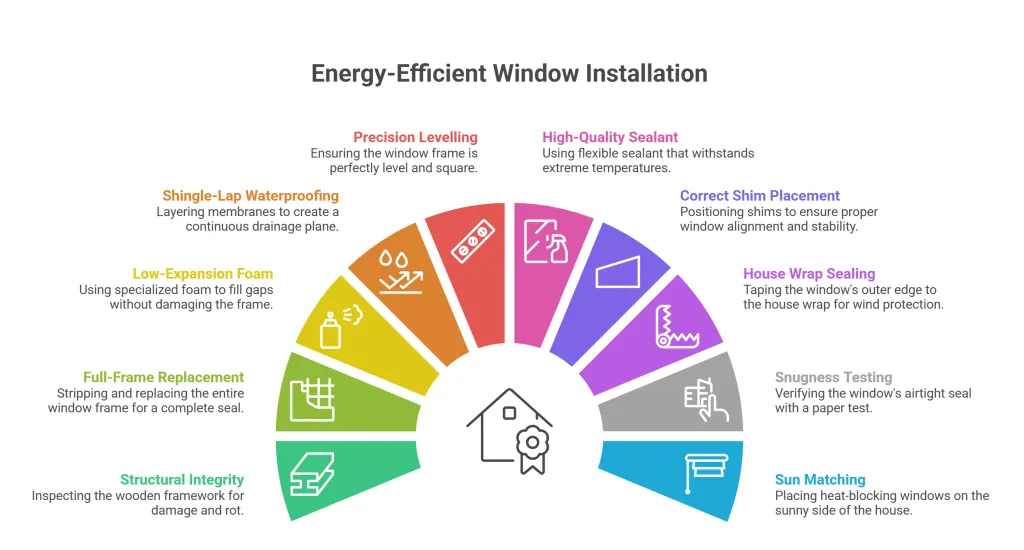
True efficiency happens in the small gaps between the window and your house. To get the most out of your investment, you need to watch the details that most people skip. Below are the practical, field-tested tips for energy-efficient window installation to make sure your home stays tight and your bills stay low:
1. Inspect the Structural Integrity of the Rough Opening
Before the new window unit is positioned, you must carefully examine the wooden framework inside your wall.
In the industry, this is known as the rough opening. The condition of this wood determines whether your new investment will actually perform as intended or fail within a few seasons.
While the old window is out, check the studs for any signs of water damage or wood rot. Replacing a damaged board at this stage is a simple and inexpensive fix that ensures your new window has a solid foundation for the next thirty years.
Check out this guide on what style of window is most energy efficient.
2. Prioritize a Full-Frame Replacement for a Complete Seal
When you are looking for the best results, you generally have two choices:
- A pocket insert or a full-frame replacement.
- A pocket insert simply slides a new window into your existing frame.
While this second one is often cheaper and faster, it leaves the old wood and hidden gaps untouched. For a truly energy-efficient home, a full-frame replacement is the superior method.
This process involves stripping everything away until you reach the structural studs of the house. By removing the old casing and brickmould, installers can apply new insulation and moisture barriers directly to the wall.
3: Use the Right Kind of Foam
Don’t use the standard stuff from the hardware store that expands like crazy. It can actually bend your new window frame. Use low-expansion foam made specifically for windows. It fills the gaps to block air without putting pressure on the frame.
4. Implement a Shingle-Lap Waterproofing Strategy
Waterproofing is not just about applying tape; it is about managing the path of gravity. To keep your home dry, you must install flashing membranes in a specific sequence known as the shingle-lap method.
This technique means each layer of moisture protection overlaps the one beneath it, creating a continuous drainage plane.
The process starts at the bottom of the window with the sill pan. You then move to the side jambs and finally finish with the head flashing at the top. By layering the materials this way, any water that manages to get behind your siding will naturally flow over the seams and toward the ground.
5. Verify Precision with a Zero-Tolerance Levelling Standard
A window that is even slightly tilted will eventually become a major source of energy loss. If the frame is not perfectly level, square, and plumb, the moving parts of the window will not align with the stationary seals.
This misalignment prevents the locks from pulling the sash tightly against the weatherstripping, leaving microscopic gaps where air can freely bypass the glass. You should never settle for a fit that is simply close enough.
6: Don’t Skimp on the Sealant
The exterior sealant is your home’s final line of defence against the elements. Many people make the mistake of using standard, hardware-store silicone that dries out and cracks after a single season.
To ensure a professional result, you must use a high-quality thermoplastic sealant that remains flexible even in sub-zero temperatures. This flexibility allows the window to expand and contract without breaking the seal.
Use a high-quality sealant that stays flexible when it’s -20°C outside.
You can read this complete guide on common window problems to understand how poor sealing often leads to drafts, moisture buildup, and long-term damage.
7: Use Shims Correctly
Shims are the small, wedge-shaped spacers used to position the window perfectly within the rough opening. While they seem like minor components, their placement is critical for the long-term operability of the unit. You must place shims at every structural point.
If the shims are too tight, they can bow the frame and cause the window to bind when you try to open it. If they are too loose, the window may shift over time.
8: Seal the Window to the House Wrap
Your house is wrapped in a protective layer (like Tyvek). Make sure your window’s outer edge is taped directly to this wrap. This stops wind washing, where cold air gets behind your siding and steals the heat right through your walls.
9: Test the Snugness Before Finishing
Before you install the final interior trim, you must confirm that the window is creating a true airtight seal. The most effective way to do this is with a simple compression test. Close and lock the window, then try to slide a thin piece of paper between the sash and the frame.
If the paper slides through easily, the window is not tight enough, and the weatherstripping is not fully engaged.
This is your last chance to make adjustments while the mounting screws and shims are still accessible.
10: Match the Window to the Sun
Make sure the windows designed to block heat go on the sunny side of your house. If the installers mix them up and put heat-trapping glass on the south side, your living room will feel like an oven all summer.
These 10 tips can make the difference between a drafty room and a perfectly insulated sanctuary. However, it totally depends on how much attention is paid to the mechanical details during the actual workday.
You are the one in control of your home’s comfort, and following these tips for energy-efficient window installation ensures your investment pays off for years to come.
Make sure you or your contractor never treats these steps as optional suggestions. Even with the best intentions, mistakes happen during a busy renovation. For that reason, we are covering exactly what can go wrong when the pressure is on next.
What Are the Most Common Window Installation Mistakes to Avoid?
The financial stakes of a botched installation are higher than most homeowners realize. A high-performance window is built to last decades, but a single fitting error can cut its efficiency by 50% immediately.
In Ontario, these aren’t just small leaks. They are structural liabilities that lead to expensive utility bills and mould growth.
Replacing windows in an average home often costs between $10,000 and $20,000. Allowing a quick and cheap install to ruin that investment is a major financial risk. It is rarely the glass that fails. Usually, it is human error during the setup.
To protect your money, you must spot the mistakes that lead to total system failure. What are the most common window installation mistakes to avoid? Below are the critical errors that quietly drain bank accounts across the province.
Measuring only once and at one point
A single measurement taken at the middle of the opening misses any variation in width or height caused by settling, renovation work, or original construction inconsistencies.
The resulting window may be slightly too small in one direction. Unfortunately, this creates a gap that no amount of caulking can fully seal against Ontario winters.
Poor or missing flashing
Flashing is not optional in Ontario. It is the physical barrier between water and your wall structure. Missing flashing or flashing applied without proper overlap at the corners allows water to travel directly into the wall during heavy rain and freeze inside it during winter.
This is the single most common cause of water infiltration behind window frames in Ontario homes, and the moisture around windows that homeowners often mistake for a window quality problem.
Over-foaming the gaps
Low-expansion spray foam applied too liberally continues expanding after the can is put away. The resulting pressure pushes against the inside of the window frame and bends it slightly inward.
That distortion breaks the compression seal around the glass unit and creates air leakage that is nearly impossible to fix without removing and reinstalling the window entirely.
Installing into a damaged rough opening
Rot or moisture damage in the surrounding wall structure does not stop spreading once the new window goes in on top of it. The new window will be sitting in a weakening structure from day one and will begin showing signs of failure within a few years.
Every sign of damage in the rough opening needs to be addressed and fully repaired before installation begins.
Not checking the window operation after securing the frame
A window that sticks slightly when closing or does not lock without effort is telling you it is out of alignment. That misalignment means there is a gap somewhere along the perimeter seal when the window is in the closed position.
DIY installation
DIY installation voids the manufacturer’s warranty on most energy-efficient window products. If the glass seal fails, the frame warps, or any other product defect develops, the manufacturer has no obligation to cover it.
Any water damage or structural repair that results from an improper installation falls entirely to the homeowner. For a full picture of what that can look like, read our guide on the 10 signs your windows need replacing.
Why Choose a Professional Window Installation Service in Ontario?
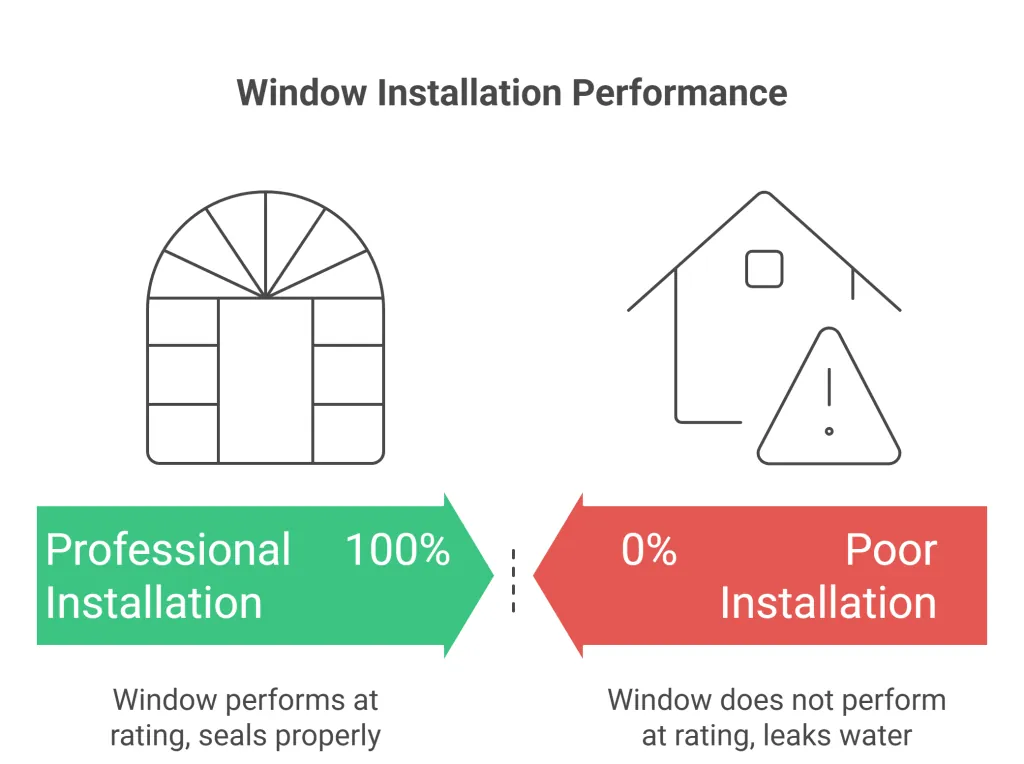
The window you choose matters. But how it gets installed determines whether that choice was worth it.
A professionally installed energy-efficient window performs at the rating on its label. It seals properly against Ontario winters, it does not let water into your walls, and the manufacturer’s warranty remains valid for the life of the product.
A poorly installed window of the same specification does none of those things. The difference is entirely in the hands of the people who fit it.
Panorama Windows & Doors’ certified installation team handles every project with in-house installers who are trained to manufacturer standards and fully covered under WSIB and liability insurance.
We work across Ontario and understand exactly what the province’s climate demands from a window installation, from the freeze-thaw pressure on flashing seals to the vapour barrier requirements of the building code.
If you are looking for a reliable window replacement service or specifically need trusted Oshawa window installation, our team brings the same standard of work to every job. When you invest in high-performance windows, you deserve an installation that protects that investment from the first day to the last.
Final Thoughts
Getting the right windows is a good decision. Getting them installed correctly is what makes it a smart one. A quality product fitted poorly will cost you in heating bills, repairs, and voided warranties long before you ever recover the investment.
Most Ontario homeowners only find out something went wrong when temperatures drop and the drafts return.
Do the checks, ask the right questions before you hire, and make sure the person fitting your windows knows the job as well as the product.
Did you find this guide on tips for energy-efficient window installation useful? Share it with someone planning a window upgrade, or leave a comment below with any questions. We read everyone.
Written by Alex Soroka, Senior Project Manager.