

If your heating bill keeps climbing every winter, your windows might be the reason.
The U.S. Department of Energy found that windows are responsible for 25 to 30 percent of a home’s heat loss. That is a significant number for any Ontario homeowner already dealing with high utility costs.
Energy-efficient windows are one of the most practical upgrades you can make to fix that. They lower your heating and cooling costs, keep your home comfortable through every season, and even protect your furniture from sun damage.
This is just one reason you should choose to modernize your home’s exterior.
In this blog, we will break down the essential benefits of energy-efficient windows. We’ll cover how they save you money, increase your property value, and keep the Canadian cold at bay.
We will also look at local incentives that make these upgrades more affordable.
Ready to stop wasting money on lost heat? Let’s dive in.
What Are Energy-Efficient Windows?
Many of you might have heard about green home upgrades lately. Though these were not so popular before, they are now a standard for modern living.
Think about our surroundings here in Ontario. Our homes face punishing winters and humid summers. Standard windows simply can’t keep up with those extremes.
Energy-efficient windows are high-performance systems designed to minimize the transfer of heat between your home and the outdoors. That means your indoor climate stays consistent regardless of the weather.
Either you are keeping the furnace heat inside during a January blizzard, or you are blocking the searing July sun. However, let’s now give you a short explanation of what parts it includes to work as an energy-efficient:
Double or Triple Glazing: Instead of one thin sheet of glass, these use two or three. The layers create a buffer zone that prevents the cold from touching the inner glass.
Argon Gas Fill: Manufacturers pump a dense, non-toxic gas between the panes. It moves much more slowly than air, acting as a heavy blanket to stop heat from drifting out.
Low-E Glass Coatings: This invisible silver layer acts like a thermal mirror. It reflects your indoor heat back into the room while bouncing harsh UV rays away from your carpet.
Insulated Frames: High-quality frames use materials like vinyl or fiberglass with foam-filled cores to stop drafts at the source.
Things might sound a bit technical, but these components are what make the real difference in your comfort. We are just getting started, and once you see the impact on your utility bills, you might end up wondering why you didn’t upgrade sooner.
So, let’s now learn about how energy-efficient windows work and their features.
If you want to understand which types of windows fit your home best, we have a guide already written for you to read before going further.
How Do Energy-Efficient Windows Work? Key Features and Technologies
Energy efficiency itself is no longer just a buzzword; it is a fundamental shift in how we engineer our living spaces. When no one was paying attention to thermal bridging decades ago, we relied on heavy insulation in walls while leaving our windows as massive holes for heat to escape.
People often misjudge windows as mere decorative glass, failing to realize they are actually the most active part of a home’s skin.
However, it is now on your shoulders to make an informed decision for your property. To do that, you need to know clearly about the internal mechanics that separate a standard glass pane from a high-performance thermal shield.
Here is the exact process of how these windows actually function to protect your home:
1. The Initial Solar Interception (Low-E Filtration)
The process begins the moment a photon of light hits the exterior surface. Instead of letting every ray pass through, a microscopically thin Low-E (low-emissivity) coating acts as a selective filter.
In the summer, it reflects long-wave infrared energy (heat) back toward the street. In the winter, it does the opposite. It detects the heat trying to leave your living room and bounces it back toward your furnace. This is the “brain” of the window.
2. Thermal Deceleration via Gas Insulation
Once heat manages to pass the first layer of glass, it hits a wall of invisible density. In standard windows, air inside the panes circulates, carrying heat from one side to the other. In energy-efficient models, the space is vacuum-sealed and filled with Argon or Krypton gas.
Because these gases are significantly denser than oxygen, they move much more slowly. This creates a “thermal traffic jam,” making it incredibly difficult for the Ontario cold to migrate toward your interior glass.
3. Edge-to-Edge Moisture and Temperature Control
While the center of the glass is protected by gas, the edges are often the weakest point. High-efficiency windows utilize warm-edge spacers made of non-metallic, structural materials. This is where the magic of condensation control happens.
By keeping the edges of the glass panes at a consistent temperature, the window prevents the sweating common in older homes. This means the structural integrity of your window frame remains intact and free from wood rot or mold.
4. Multi-Chambered Frame Support
The final stage of the process involves the frame itself. Whether you choose vinyl, fiberglass, or composite, the frame is not solid; it is filled with multiple small chambers or specialized foam.
These chambers trap air to provide further insulation, ensuring that the draft isn’t just stopped by the glass, but also by the very material holding the window in place. This creates a complete seal against the harsh wind pressures common in the GTA and across Ontario.
Are you feeling overwhelmed by all these technical layers? Look, the benefits of energy-efficient windows will only truly make sense when you realize these components are working 24/7 without you ever lifting a finger.
In fact, most homeowners forget these technologies even exist until they see their monthly utility statement.
If you don’t care about the science, you will certainly care about the silence and the savings. That is why many people in our province are making the switch before the next major cold snap hits.
So, we have got much knowledge already regarding how.
Let’s now go in-depth and explore the specific, long-term benefits of energy-efficient windows for your wallet and your lifestyle.
What Are the Key Benefits of Energy-Efficient Windows for Your Home?
A window is not just a glass panel in your wall. It controls how much heat stays inside your home, how comfortable your rooms feel through every season, and how much you spend keeping them that way.
For Ontario homeowners dealing with cold winters and rising energy costs, choosing the right windows requires more thought than most people give it.
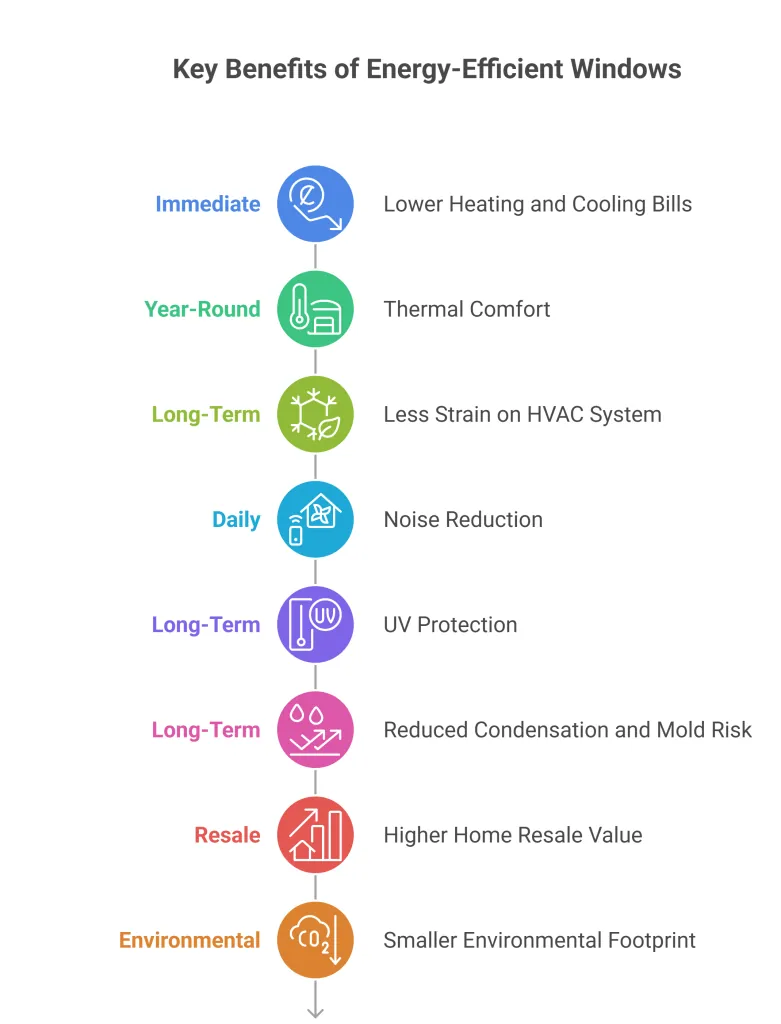
Energy-efficient windows have become one of the most practical home upgrades available today, and for good reason. Below are the key benefits you can expect when you make the switch.
1. Lower Heating and Cooling Bills
This is the most immediate benefit most homeowners notice. Energy-efficient windows reduce heat loss in winter and block unwanted heat in summer, which means your furnace and air conditioner run less often.
ENERGY STAR certified windows save an average of 12 percent on annual energy bills. If you are replacing single-pane windows, you can expect to save between $125 and $465 per year, depending on your home size and climate. Even replacing older double-pane windows can save between $27 and $197 per year.
Those numbers add up fast over the 20 to 30-year lifespan of a quality window.
2. Year-Round Thermal Comfort
Lower bills are one thing. But the comfort improvement is what homeowners talk about most after an upgrade.
Energy-efficient windows maintain a consistent indoor temperature by creating a proper thermal barrier between inside and outside. Cold drafts near windows disappear. Hot spots next to glass in summer go away. Rooms that felt impossible to heat in January start behaving like the rest of the house.
For Ontario homes that deal with temperature swings from minus 20 in winter to 35 degrees in summer, that stability makes a real difference every single day.
3. Less Strain on Your HVAC System
This is the most considerable one among all the benefits of energy-efficient windows that most homeowners overlook completely.
When your windows leak heat, your furnace or air conditioner has to work harder to compensate. That extra workload shortens the lifespan of your heating and cooling equipment and increases how often it needs repairs.
Upgrading your windows reduces how long your HVAC system runs each day. Less runtime means less wear, fewer service calls, and a longer time before you face the cost of a full system replacement.
For older homes where window replacement is long overdue, this indirect saving alone can justify a significant portion of the upgrade cost.
4. Noise Reduction
Energy-efficient windows do reduce outside noise, but it is important to understand what actually drives that result.
The number of glass panes, the thickness of each pane, and the spacing between them are what dampen sound. Argon gas fill, while excellent for thermal performance, does not reduce noise on its own. This is one of the most common misconceptions in window marketing and is worth knowing before you buy.
A quality double-pane window reduces noise to around 35 decibels.
A triple-pane window can bring that down to around 51 decibels. If you live near a busy road, a highway, or in an urban area, the difference is noticeable and genuinely improves daily life at home.
5. UV Protection for Your Furniture, Flooring, and Artwork
Standard windows block very little ultraviolet light. Over time, that constant UV exposure fades hardwood floors, bleaches upholstery, and degrades artwork, carpets, and window treatments. Most homeowners do not connect the damage to their windows until it is already done.
Low-E glass blocks up to 95 percent of UV rays while still letting natural light fill your rooms comfortably. Your flooring, furniture, and interior finishes stay in better condition for longer. That means fewer refinishes, fewer replacements, and real money saved over the years without you having to think about it.
6. Reduced Condensation and Mold Risk
Old windows have a major flaw, which is that the glass gets freezing cold. When warm indoor air hits that cold glass, it turns into water. This moisture then drips down your frames and into your walls.
If left alone, this causes big problems. You’ll deal with mold, wood rot, and peeling paint. These repairs are expensive. Often, the damage is hidden until it’s a total mess.
Energy-efficient windows keep the interior glass surface warm enough that condensation rarely forms. If you have already noticed moisture around windows, it is a reliable sign that your current windows are actively working against your home’s health and structure.
7. Higher Home Resale Value
Upgrading to energy-efficient windows is one of the few home improvements that pays you back both while you live there and when you sell.
Studies consistently show that homeowners recoup 65 to 80 percent of their window replacement cost at resale. Homes with updated, certified windows attract stronger buyer interest and tend to sell faster.
Today’s buyers actively look for features that lower ongoing utility costs, and energy-efficient windows are near the top of that list.
New windows also improve curb appeal immediately. Clean, modern frames with no fogging, no rot, and no visible wear signal a well-maintained home before a buyer ever steps inside.
8. A Smaller Environmental Footprint
Every time your HVAC system runs less, less energy is consumed, and fewer greenhouse gases are released.
Replacing single-pane windows with double-pane energy-efficient models can reduce a household’s carbon dioxide emissions by 1,000 to 6,200 pounds per year, depending on your home size and energy source.
Choosing ENERGY STAR certified windows means the product has been independently tested and verified to meet strict performance standards set by the U.S. Environmental Protection Agency.
For Ontario homeowners who want to reduce their environmental impact in a practical, measurable way, this is one of the most effective upgrades available.
Energy-efficient windows offer a lot: lower bills, better comfort, and higher home value. But you won’t truly see these benefits of energy-efficient windows on a spec sheet. You notice them when your heating bill finally drops.
You feel them when a drafty room stays warm all winter. Every benefit becomes real when the windows match your home and the Ontario climate.
However, picking the wrong glass or frame material can ruin your investment. Not sure where to start? The next section covers exactly what you need to look for before spending a dollar.
What to Consider Before Buying Energy-Efficient Windows
When most homeowners start looking at energy-efficient windows, they go straight to the glass. Double-pane or triple-pane, Low-E coating, argon gas fill. That is all important. But the glass is only part of what determines whether a window actually performs the way it should in your home.
The frame material, the certification label, your specific climate zone, and even the timing of your purchase can all change how much value you actually get out of the upgrade.
And in some cases, depending on the condition of your current windows, a different home improvement might give you a better return first.
There is a lot to weigh before spending $300 to $1,000 per window. So here are the most important things Ontario homeowners should consider before buying:
Check Your Current Windows First
Are you replacing single-pane glass? You’ll see the benefits of energy-efficient windows immediately. Do you already have double-pane windows in good shape? If so, upgrading your attic insulation might actually save you more money right now. Know your starting point.
Ontario Has Multiple Climates
A window built for Toronto might struggle in Thunder Bay. Your specific region determines the U-factor you need. Don’t just buy what looks good online; buy for your local weather.
The Frame is Just as Important as the Glass
Don’t get so focused on the glass that you ignore what’s holding it in place. The frame material determines how long your window lasts and how well it seals out the wind. In Ontario, your choice usually comes down to three options:
Vinyl: This is the go-to for most homeowners. It is budget-friendly, never needs painting, and handles our humidity well. It’s a great way to get the benefits of energy-efficient windows without a massive price tag.
Fiberglass: Think of this as the “premium” choice. It’s incredibly strong and expands at the same rate as the glass, which prevents seal failure.
Aluminum: You should generally avoid this in a cold climate. Metal conducts heat and cold instantly. In an Ontario winter, an aluminum frame will feel like an ice cube and likely cause heavy condensation issues inside.
Look for the Label
If it isn’t certified, the numbers are just guesses. Look for ENERGY STAR or NFRC labels. These prove that a third party actually tested the window’s performance. No label means no proof.
Budget for Installation
Homeowners often forget the “installed” price. Expect to pay between $300 and $1,000 per window for labor. Also, remember that triple-pane glass takes longer to pay for itself through energy savings than double-pane.
Know the Rebate Status
The final thing you should definitely check before buying an energy-efficient window is the Rebate status.
The federal tax credit for windows expired at the end of 2025. If you installed Windows before then, you can still claim them. For 2026, those credits are gone. However, check your local Ontario utility provider. Some still offer rebates for high-efficiency upgrades.
Take your time to vet local contractors and ask for proof of certification. While the technical specs matter, the long-term value comes from a professional fit.
In this case, the most important decision you can take so far is choosing a partner who combines industry-leading products with a deep understanding of local architectural standards and climate demands.
This is where a specialized, local professional becomes your most valuable asset.
Why Partner with Panorama Windows & Doors?
We know that every window we install is a promise of comfort for an Ontario family. That’s why we take a personal approach, treating every client like family and guiding you through the buying process without high-pressure sales tactics.
Our reputation is built on serving Ontario homeowners since 2015, from the humid GTA to the freezing winters in Sudbury. This local expertise earned us the 2026 Consumer Choice Award for Windows & Doors in Barrie.
Don’t leave your comfort to chance. If you are looking for an honest, trustworthy partner to help you maximize the benefits of energy-efficient windows, we are ready to help.
Visit panoramawindows.ca today to get an online quote or call us to schedule your free in-home consultation.
Final Thoughts
Energy-efficient windows are not a glamorous upgrade. They do not change how your home looks from the street. But they change how it feels to live in every single day, how much you spend keeping it comfortable, and what it is worth when it is time to sell.
That makes them one of the most quietly powerful investments an Ontario homeowner can make.
Yes, the upfront cost is real. But so are twenty to thirty years of lower bills, a healthier home, and stronger resale appeal.
So, you now have all the information that can help you choose the best energy-efficient windows for your home.
If you found this guide helpful, share it with someone planning a home upgrade or drop a comment below with any questions. We read everyone.
Written by Alex Soroka, Senior Project Manager.