

When the first real cold arrives, a lot of Ontario homeowners wake up to foggy windows and assume the worst. Sometimes the windows really have failed. More often the fog is telling you something about the air in your house, not the glass. The trick is knowing which one you are looking at, and that comes down to one question: where exactly is the fog?
I look at foggy windows every winter, and I can usually tell what is going on in the first ten seconds. Here is how you can do the same before you call anyone.
The One-Minute Test
Put your finger on the fogged area from inside the room.
- If your finger leaves a clear streak, the moisture is on the inside surface of the glass. That is condensation from indoor humidity.
- If nothing changes, go outside and try the outside surface. If it wipes off there, it is outdoor condensation.
- If it does not wipe off from either side, the moisture is between the panes. The seal on the glass unit has failed.
Fog on the Inside of the Glass
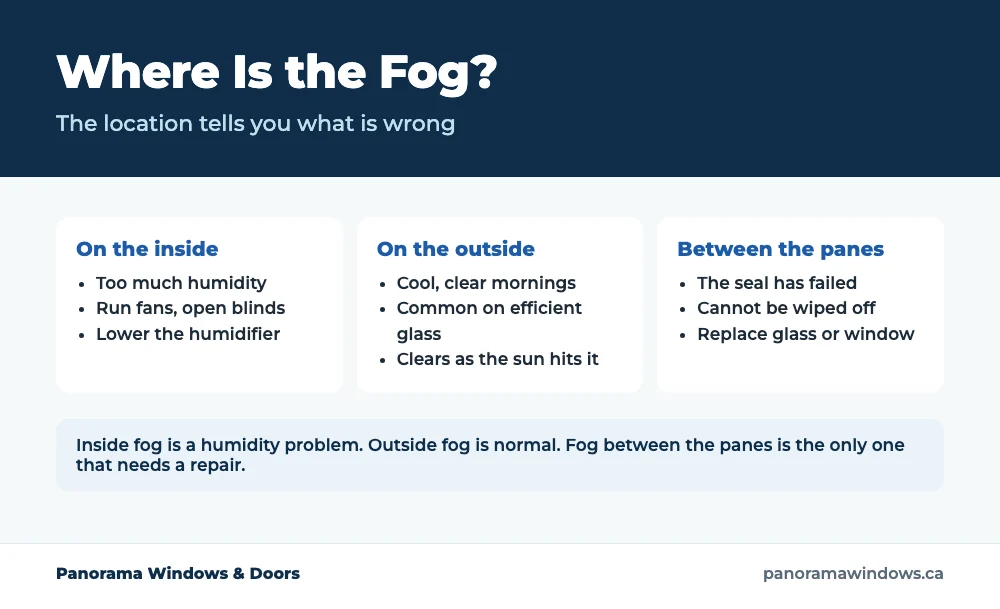
This is the most common winter call I get, and the window is usually fine. Warm indoor air holds moisture. When that air touches the coldest surface in the room, the moisture condenses. In winter the coldest surface is the glass, and the bottom edge of the glass is the coldest part of it, which is why fog and ice often start there.
Inside condensation gets worse when:
- a humidifier is set high, or the house has a lot of cooking, showers or drying laundry
- blinds and curtains are closed tight, so warm room air never reaches the glass
- the house has just been made tighter, for example with new windows or insulation, so moisture that used to leak out now stays in
- the windows are older double-pane units with a colder inner surface
The fixes are about moisture and air movement: run bathroom and kitchen fans, open blinds during the day, keep heat registers below windows clear, and turn the humidifier down when the outdoor temperature drops. Our guide on stopping ice buildup on windows in an Ontario winter goes into this in more detail, and our answer on moisture around windows in Ontario homes explains why water near a window is not always a window problem.
If you have just had new windows put in and they are sweating, that is common in the first cold snap. I cover it in our answer on condensation on new windows in an Ontario winter.
Fog on the Outside of the Glass
This one surprises people, especially after they buy new windows. On cool, clear mornings you may see fog on the outside of the glass that burns off as the sun reaches it. It happens because energy-efficient glass keeps the heat inside, so the outer pane stays as cold as the night air and dew forms on it, the same way it does on a car windshield.
Outdoor condensation is not a defect. In a sense it is a sign the glass is doing its job. Nothing needs fixing.
Fog Between the Panes
This is the one that does need attention. A double- or triple-pane window is a sealed unit: two or three layers of glass joined at the edges with a spacer and sealant, often filled with an insulating gas. When that edge seal fails, humid air gets into the space between the panes. You see fog, haze, white streaks or a film that no amount of cleaning removes, and it usually gets worse on cold days.
A failed seal means:
- the insulating gas has leaked out, so the window insulates less well than it did
- the fog will not go away on its own
- the view gets worse over time as minerals build up on the inner surfaces
It is not an emergency, and the window still keeps the weather out. But it does not fix itself, so it belongs on your repair list.
Replace the Glass or the Whole Window?
If the frame and sash are solid and the window seals and locks properly, replacing just the sealed glass unit can be the right fix. If the frame is rotting or warped, the window is drafty, or several units have failed at once, a full replacement is usually better value. I go through how to decide in our answer on replacing just the glass in a foggy window in Ontario.
When the whole window is the answer, our window replacement service in Ontario and our triple-pane windows for Ontario homes pages cover the options. Triple-pane glass keeps the inner pane warmer, which also helps with inside condensation.
Which Windows Fail First?
In my experience, seal failures show up first on windows that take the most punishment: south and west windows that cycle between strong sun and cold nights, windows where water sits on the sill, and older units near the end of their life. If one window in a set has failed, it is worth checking the others built at the same time.
We see all three kinds of fog every winter in the homes we visit, from window replacement in Hamilton to windows and doors in London, Ontario and windows and doors in Kitchener. The test above works the same everywhere.
Frequently Asked Questions
Why are my windows foggy on the inside in the morning?
Overnight the glass gets colder and indoor moisture condenses on it. Lowering indoor humidity, opening blinds and running exhaust fans usually clears it up.
Can fog between window panes be fixed?
The fog cannot be removed in a way that restores the seal. The fix is to replace the sealed glass unit or the whole window.
Is condensation on the outside of my windows bad?
No. It is common on energy-efficient glass on cool, clear mornings and clears as the day warms up.
Does a foggy window waste energy?
A window with a failed seal insulates less well than it did when new because the insulating gas has escaped. Inside or outside condensation alone does not mean the window is losing energy.
Not Sure Which Fog You Have?
Book a free in-home consultation anywhere in Ontario and I will tell you whether it is a humidity issue, a glass unit or a whole window.
Written by Alex Soroka, Senior Project Manager.