

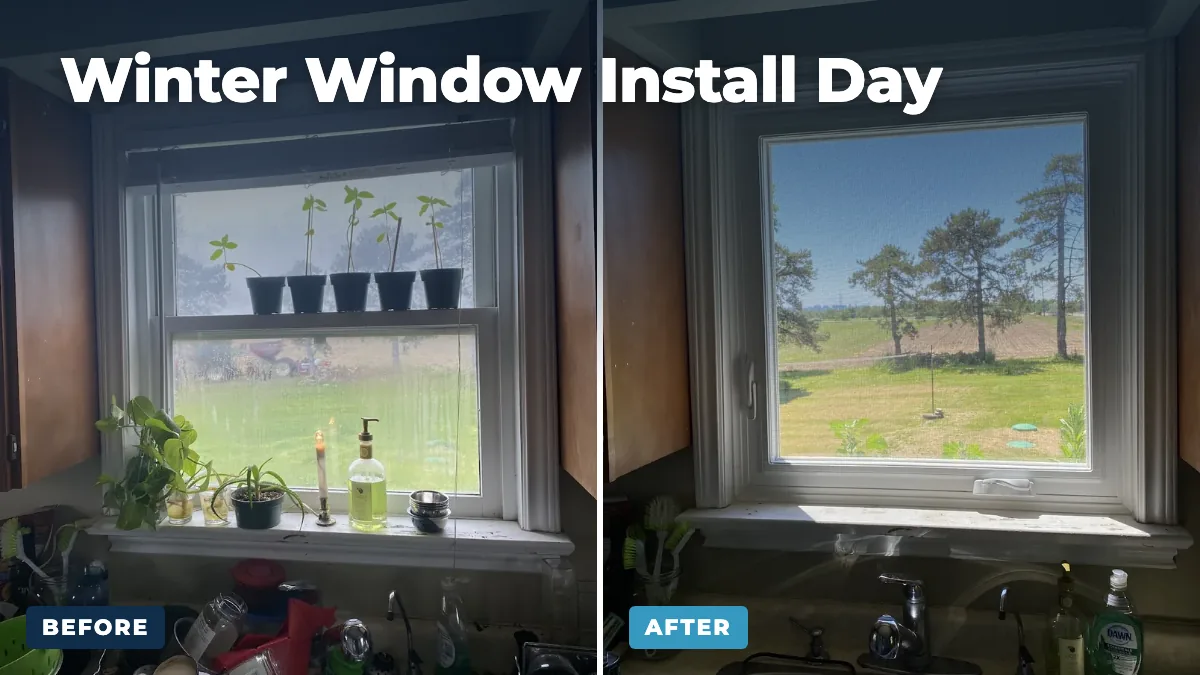
Every November my phone fills up with the same question, asked a dozen different ways: "Can you really put windows in when it's this cold?" People picture the whole side of the house open to the wind while the furnace runs flat out. That is not what a winter install looks like when it is done properly, and I want to walk you through what actually happens on the day.
I manage installations for Panorama Windows & Doors, so I see the whole job from ordering to the final walkthrough. This is the honest version, including the days I tell a crew to stay home.
The Short Answer
Yes, windows can be replaced through an Ontario winter. The work is planned around two things: keeping each room open for as short a time as possible, and using sealants and foam that are made for the temperature on the day. Get those right and a December install ends up as tight as one done in June.
What Install Day Looks Like, Step by Step
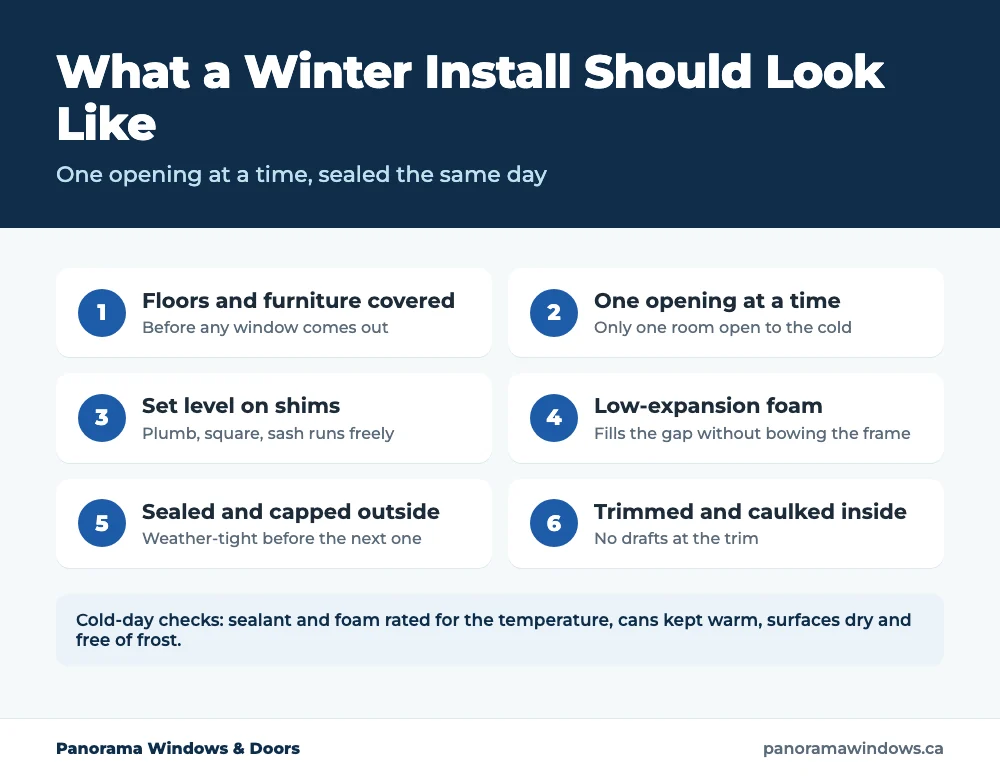
1. We protect the room first
Before a single window comes out, floors get covered and furniture near the opening gets moved or covered. In winter this matters more than usual, because boots carry in snow and salt. If you can clear a path from the door to each window the night before, the day goes faster for everyone.
2. One opening at a time
This is the part that answers most of the worry. A good crew takes out one window, installs the new one and seals it before moving to the next. That means only one room is open to the outside at any moment, and only for the time it takes to swap that window. You can close the door to that room to keep the rest of the house warm while the crew works.
3. The new window is set level, plumb and square
The new window sits on shims so it is level and square in the opening, and the sash should open and close without binding. This step does not change with the season, but it is where a rushed cold-day install can go wrong. If a crew is hurrying because they are freezing, the window ends up slightly out of square, and you find out in March when it will not lock.
4. The gap is filled with low-expansion foam
The space between the window frame and the wall gets filled with a low-expansion foam made for windows and doors. Ordinary expanding foam can push the frame inward so the window will not open. In winter the foam itself needs attention: cold cans do not spray or cure properly, so they are kept warm, and some products are rated for much lower temperatures than others.
5. The outside is sealed and capped
Outside, the perimeter is sealed and finished with aluminum capping or trim. This is the step that decides whether a winter install is good or bad. Most standard exterior sealants are rated for use above roughly 4 to 5°C on a dry surface, and sealant will not bond to frost or ice. On a cold day that means using a sealant rated for the temperature, keeping it warm before use and making sure the surface is dry and clean. I go into the numbers in our answer on how cold is too cold to install windows in Ontario.
6. The inside is trimmed and caulked
Inside, the window is trimmed and caulked so there are no drafts at the edges. Then we clean up, check that every sash opens, closes and locks, and walk you through the hardware.
When I Reschedule
Cold on its own rarely stops us. These do:
- Freezing rain. Wet surfaces that freeze will not take sealant, and ladders on ice are not worth the risk.
- Strong wind. Handling a large window or patio door in high wind is a safety problem, and it blows cold air straight through the open room.
- A deep cold snap. When it is cold enough that even cold-rated products are at the edge of their range, it is better to wait a few days.
Moving a date by a couple of days is a small price for a window that seals properly for many winters to come.
Why Some People Prefer Winter
Winter installs have a few real advantages:
- You feel the difference immediately. On a cold night, the room with the new window is the one you stop avoiding.
- Drafts are easy to find. On a cold day it is obvious where air is coming in, both before the old window comes out and after the new one is in.
- Booking is often easier. Spring and summer are the busiest months for most window companies, so winter dates are usually easier to get.
If you are still deciding on timing, our seasonal guide to the best time to replace windows in Ontario compares each season, and our article on the best time of year to replace windows in Barrie looks at it for Simcoe County winters.
How to Get Your House Ready
- Clear about a metre of space in front of each window inside.
- Take down blinds, curtains and rods, or let the crew know which ones you want them to remove.
- Shovel and salt a path to each window outside, including the side yards.
- Move pets and plants out of the rooms being worked on, since those rooms will get cold for a short time.
- Turn the heat up a degree or two in the morning. The house holds that warmth while each room is opened briefly.
What to Ask Before You Book a Winter Install
- Do you remove and install one window at a time?
- Which sealant and foam do you use in the cold, and what temperature are they rated for?
- Who installs: your own crew or a subcontractor?
- What happens if the weather turns on the day?
- What does your warranty cover for the installation itself, not only the window?
Our crews work out of our head office for windows and doors in Barrie and our branch offices, and we install through the winter across the province, including window replacement in Sudbury and window replacement in Collingwood, where winters arrive early. Our window replacement service in Ontario page covers the full process, and if your windows are fogged or failing, read foggy windows in an Ontario winter first.
Frequently Asked Questions
Will my house get cold during a winter window installation?
Only the room being worked on, and only while that one window is out. Closing the door to that room keeps the rest of the house warm.
How long does it take to replace a window in winter?
About the same as in summer for the window itself. Cold weather adds a little time for warming products and making sure surfaces are dry before sealing.
Is the caulking weaker if it is applied in winter?
Not if the sealant is rated for the temperature and applied to a clean, dry, frost-free surface. Problems come from using the wrong product or sealing over ice.
Can a patio door be replaced in winter too?
Yes. The opening is bigger, so the crew needs a calm day, but the same one-opening-at-a-time approach applies.
Thinking About a Winter Install?
Book a free in-home consultation anywhere in Ontario and I will make sure your install date, products and crew are planned for the weather, not just the calendar.
Written by Alex Soroka, Senior Project Manager.