

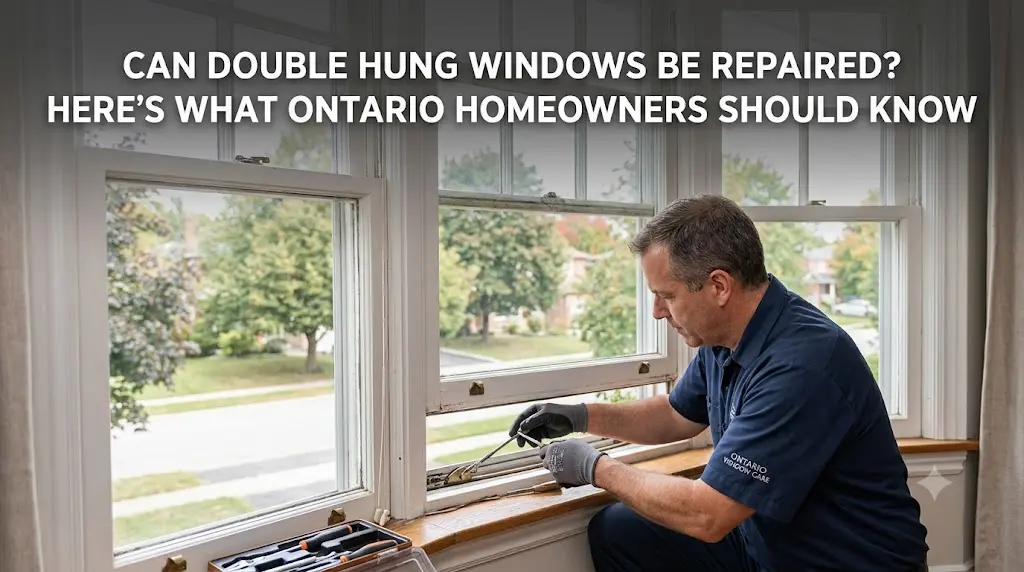
Yes, most double hung windows can be repaired. Balances, locks, weatherstripping, and screens all use replaceable parts. Rot, cracked frames, and failed seals usually point to replacement instead.
That answer carries more weight here than it would in a milder climate, because the homes move through deep frost, spring thaw, and humid summers within a single year. Windows absorb every bit of that movement, which is why a sash that glided in 2005 now binds every July.
Most homeowners simply want an honest assessment rather than a sales pitch. Read on to learn which repairs are worth your money, and which ones only postpone a larger bill.
Can Double Hung Windows Usually Be Repaired?
Yes. If the window still opens and the surrounding wood feels solid, a repair will hold. Replacement makes better sense once rot sets in or the parts are discontinued.
Here is the quick reference our installers work from during in-home assessments.
| Symptom | Repairable? | Typical fix |
| Sash won’t stay up | Yes | Balance or pivot shoe replacement |
| Sticks or won’t open | Usually | Clean track, strip paint, realign |
| Draught around the frame | Usually | New weatherstripping |
| Lock or tilt latch broken | Yes | Hardware swap |
| Torn screen | Yes | Re-screen |
| Fog between the panes | Glass only | New sealed unit; fog cannot be cleaned |
| Rotted or soft sash / sill | Rarely worth it | Replace the window |
| Cracked or bowed frame | No | Replace the window |
| Single-pane, pre-1990 | Not worth it | Replace the window |
How a Double Hung Window Works (and Where It Fails)
A double hung window runs on three systems. The balance sits hidden inside the side jamb and offsets the weight of the sash. The frame holds everything square within the opening in your wall. The sealed unit is the glass itself, made of two panes separated by a spacer, with argon gas sealed between them.
Balances, hardware, and sealed units are all designed to be replaced. The frame is another matter, because it sits fastened and shimmed into the wall opening, so correcting it usually means removing the whole window. That single distinction shapes nearly every repair decision on professionally installed double hung windows.
Our climate puts pressure on all three. Freeze-thaw activity is projected to become more frequent during winter across much of Canada. Barrie also sits within the Lake Simcoe snowbelt, where snow covers the ground roughly 101 days a year.
We looked at this in more detail in how Barrie’s climate affects the lifespan of residential windows.
Common Double Hung Window Problems That Repairs Can Solve
1. Window Won’t Stay Open
If your window won’t stay open, the problem is usually the window balance system. This mechanism offsets the sash weight, allowing the window to stay in position instead of sliding shut.
Older windows use a cord-and-pulley system with counterweights, while most post-1980 windows rely on a spiral balance housed inside the jamb.
The usual causes are a worn spring that has lost tension over time or a cracked pivot shoe, the small plastic block that supports the sash pin. Cold weather often makes pivot shoes brittle, which is why failures commonly show up during winter.
Repairable? Yes.
In most cases, the balance or pivot shoe can be replaced without affecting the window frame or surrounding structure. Matching the correct replacement part is the key.
2. Window Is Difficult to Open or Close
If your window feels stiff, sticks, or requires extra force to move, the problem is usually friction somewhere in the operating system. Common causes include dirt and debris built up in the track, dried lubricant, or a vinyl jamb liner that has shifted inward and started pressing against the sash.
Seasonal temperature changes can make the issue worse. As materials expand and contract throughout the year, the sash may no longer move as smoothly as it once did.
Repairable? Yes.
A thorough cleaning, proper lubrication, and minor sash or track adjustments solve most cases. Just make sure the right lubricant is used. Silicone-based products are safe for vinyl windows.
3. Window Is Stuck Shut
If your window will not open at all, paint is usually the reason. Over the years, layers of paint bridge the gap between the sash and the frame, effectively gluing the two surfaces together.
Humidity plays a part as well. Wood absorbs moisture through our humid summers and swells slightly, which is why July brings us the most calls about windows that simply will not budge.
There is an important safety point before you begin.
Health Canada advises that homes built before 1960 probably contain lead-based paint, and window trim was one of the highest-lead surfaces in the house.
With roughly 16 percent of Hamilton homes built before 1945, this affects a great many properties across our service area. Never sand or heat old paint. Score the seam with a utility knife instead.
Repairable? Yes, in most cases. Once the sash comes free, the wood underneath is usually sound. If it feels soft or spongy instead, the problem has moved beyond paint.
4. Drafts Around the Window
If you feel cold air near your window in winter, the next step is working out where it enters. Air moving through the window normally points to worn weatherstripping or a gap where the two sashes meet.
Air moving around the outside of the frame means the insulation in the wall opening has settled over the years.
You can test this yourself in about a minute. Hold a lit candle near the sash, then move it slowly along the trim and watch where the flame flickers.
Repairable? Usually.
Replacing weatherstripping is quick and inexpensive. Leaks around the frame are a different matter, because they point to how the window was installed rather than how it has worn.
Correcting those means opening the trim and resealing the opening properly, which is exactly what our professional window installation services in Barrie are built to handle.
5. Window Won’t Lock Properly
If your window lock will not turn, the lock itself is often not the real problem. The latch on the meeting rail only lines up when both sashes sit level, so a sash that has dropped slightly will throw the alignment out.
A weakening balance on one side is the usual cause. Repairing the balance frequently brings the lock back into line on its own.
Repairable? Yes.
Both the hardware swap and the balance repair are quick jobs. Do not leave this one for long, though, because a window that will not latch affects your home security and your bedroom escape route at the same time.
6. Condensation Between Glass Panes
If moisture appears between the panes of glass, the sealed unit has failed. Understanding how that unit works explains why wiping the glass never helps.
Your window holds two panes separated by a spacer, with argon gas sealed in between. That spacer is packed with drying crystals that absorb any stray moisture inside the unit.
When the seal breaks down, argon escapes and humid air works its way in. Those crystals eventually become saturated and stop doing their job, leaving moisture to condense on the inner surfaces where no cloth can reach.
Condensation on the inside surface of the glass is a completely different issue. That points to indoor humidity rather than a failed window. Health Canada recommends keeping indoor humidity around 30 to 35 percent through winter, while CMHC ties the safe ceiling to the outdoor temperature:
| Outdoor temperature | Maximum indoor humidity |
| Above -10°C | 50% |
| -10°C to -20°C | 40% |
| -20°C to -30°C | 30% |
| Below -30°C | 25% |
Repairable? Glass only.
A new sealed unit fits into your existing sash and frame. Since the glass is coming out anyway, upgrading to low-e coated glass technology at the same time restores the insulating performance the old unit lost.
7. Rotting or Damaged Window Frames
If the wood around your window feels soft, rot has already set in. It usually begins where water finds a way through, often a cracked glazing bead or a failed caulk joint, and the moisture then soaks into the exposed grain.
Our winters speed the process up. Every freeze-thaw cycle pushes trapped water deeper into the timber, and decay takes hold once the wood stays damp for long enough.
Testing for it is simple. Press the sill firmly with a screwdriver, and if the tip sinks in, the fibres underneath have already broken down.
Repairable? Rarely.
Small surface patches can be filled and sealed successfully. Softened wood no longer holds a screw securely, though, and the decay keeps spreading into the surrounding structure whatever you patch over.
8. Water Pooling in the Sill
If water collects along the bottom of your window, the drainage holes are most likely blocked. This surprises many homeowners, because a window sill is designed to shed water rather than seal it out completely.
Small openings called weep holes run along the exterior sill and drain rainwater outward. Pollen, insects, and general debris block them easily, and once they clog, water backs up and sits against the frame.
Ice makes this a distinctly local problem. A midwinter thaw fills the drainage channel, then the overnight freeze that follows seals it shut.
Repairable? Yes, and this is one job most homeowners can manage themselves. Clearing the weep holes each spring and autumn prevents the rot described above.
9. Cracked or Broken Glass
If a pane cracks, the shape of the crack usually tells you what caused it. Impact cracks spread outward from a single point, while thermal stress cracks start at the edge of the glass and curve away.
The second type happens when sunlight warms part of a pane while the edge stays cold. Partly shaded south-facing walls see this most often in early spring.
Repairable? Yes. A technician removes the trim strip holding the glass and fits a new pane. On modern windows, the whole sealed unit gets replaced rather than a single sheet.
Read More: Are Casement Windows Better Than Double Hung?
Signs Your Double Hung Window Needs Professional Attention
Repairs keep making sense until the frame stops holding square. After that, every new part you install starts wearing out ahead of schedule.
- Repeated operational problems are the clearest signal. If you have replaced the same balance twice already, a frame that has shifted out of square is pinching the sash and chewing through components.
- Significant air leaks throughout the house change the maths. One draughty window is a simple repair, but draughts appearing everywhere mean the units have aged together, and roughly a quarter of a home’s heat escapes through its windows.
- Water reaching drywall or trim tells you the window has stopped managing moisture altogether, which makes it a building envelope concern rather than a window repair.
- Rotting frames carry the same urgency, because decay travels steadily into the surrounding structure once it takes hold.
- Another common challenge is obsolete hardware. Many double-hung windows installed during the 1980s and 1990s use balances, latches, and sash components that are no longer manufactured. Finding replacement parts becomes increasingly difficult, even when the rest of the window remains functional.
This is especially relevant in Ontario communities with older housing stock, where many homes still have original windows approaching 35 to 45 years of age. In those situations, a professional assessment can determine whether repair remains cost-effective or whether expert window replacement services in Barrie offer better long-term value.
How Much Does Double Hung Window Repair Cost?

Most double hung window repairs cost between $100 and $650 in Ontario. Hardware and balance swaps sit at the low end, while a failed sealed unit sits at the top.
| Repair | Typical cost |
| Balance or pivot shoe replacement | $100 to $200 per window |
| Weatherstripping replacement | $100 to $200 per window |
| Lock or tilt latch swap | $100 to $200 per window |
| Sash cord replacement, older wood windows | $150 to $300 per window |
| Reglazing a wood sash | $250 to $500 per window |
| Wood frame repair | $175 to $300 per window |
| Vinyl or fibreglass frame repair | $300 to $600 per window |
| Sealed unit replacement | $350 to $650 per unit |
| Full double hung replacement | $700 to $1,000 installed |
Learn more about our full breakdown of window replacement costs in Ontario.
How Long Do Double Hung Window Repairs Last?
The lifespan depends on the part being repaired. A new balance often lasts 10 to 15 years, while weatherstripping typically lasts 5 to 8 years, depending on weather exposure. A replacement sealed unit may carry a warranty of 10 to 20 years.
The age and condition of the frame matter just as much. Repairing a well-maintained window can add years of reliable service. On older frames nearing the end of their lifespan, however, repairs often buy time rather than provide a long-term solution.
How to Extend the Life of Double Hung Windows
Three habits will add years to the double hung windows you already own.
- Clean the tracks and weep holes twice a year. Vacuum the channel each spring and autumn, then clear the small drainage holes along the exterior sill with a piece of wire. This single habit prevents most sticking problems and nearly all sill rot.
- Lubricate with silicone, never oil. A light spray along the tracks and balance channel keeps the sash gliding through winter. Petroleum-based products attract dirt and break down the seals and weatherstripping over time.
- Lower your indoor humidity as the temperature drops. Set the humidifier by the outdoor forecast rather than leaving it fixed all season. Dry glass means dry sills, and dry sills do not rot.
Conclusion
So, can double hung windows be repaired? In most cases yes, and repair is frequently the smarter choice while balances, hardware, and weatherstripping are the only parts failing. Once rot, seal failure, or discontinued parts enter the picture, replacement delivers better long-term value.
Book a free in-home consultation with our installation specialists, and we will tell you honestly which one your home needs.
Frequently Asked Questions
Are double hung windows in Canada worth repairing on a rental property?
Yes, provided the frame remains solid and tenants keep a working escape route. Landlords with several units usually save more by replacing during a single visit.
Can I replace just one sash instead of the whole window?
Sometimes, on newer units where the manufacturer still supplies matching sashes. Older or discontinued models rarely offer that option.
Do window repairs affect my home’s resale value?
Working windows help your sale, while fogged glass and visible rot hurt it. Home inspectors flag failed seals quickly during any transaction.
How quickly can someone come out for a repair?
Most minor repairs get scheduled within days, though replacement windows are custom-built, so allow several weeks for manufacturing.
Should I replace all my windows at once or one at a time?
Per-window costs drop noticeably when you do several together, and the rebate rewards volume as well, since it pays per opening.
Written by Alex Soroka, Senior Project Manager.