


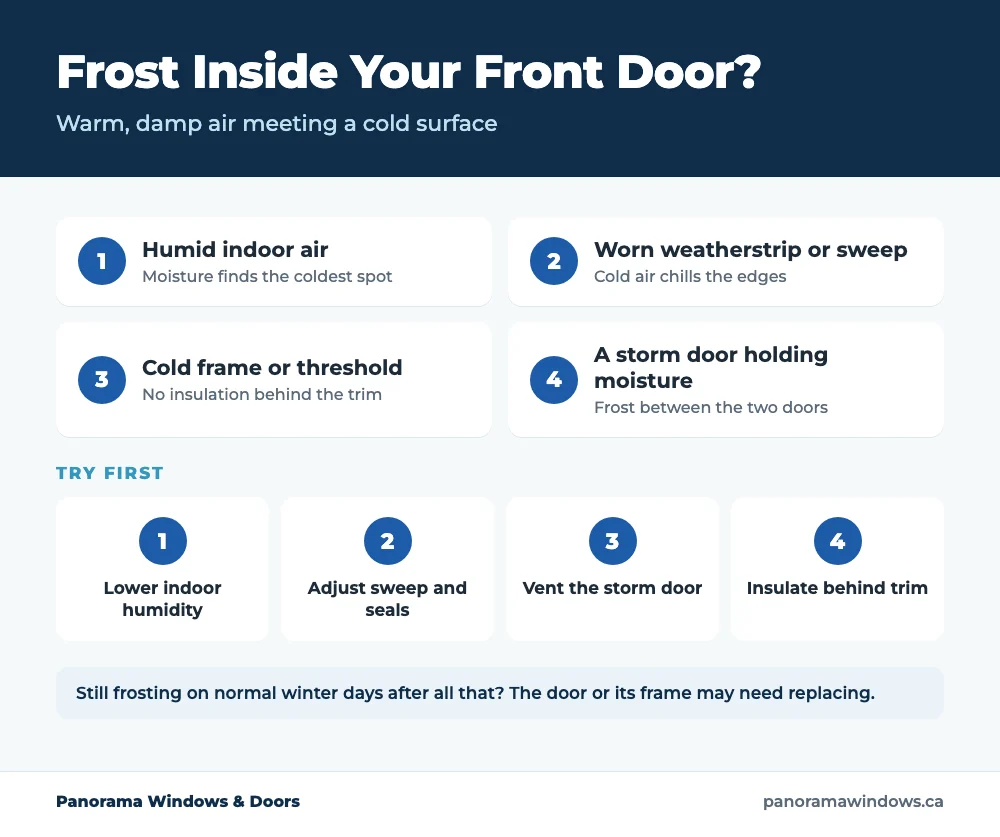
Frost forms on the inside of a front door when warm, humid indoor air meets a surface that is below freezing. On an entry door that cold spot is usually the edges, the lock area, the threshold or the frame, and it gets colder when worn weatherstripping or a gap at the bottom lets outside air in. Lowering indoor humidity and fixing the seals solves most cases. If frost keeps forming on ordinary winter days after that, the door or its frame may need replacing.
Where the Frost Usually Shows Up
When I look at a frosty door, where the frost sits tells me most of the story:
- Along the bottom edge or threshold: a worn sweep, a threshold set too low, or an uninsulated threshold.
- Around the lock and latch: metal hardware that conducts cold, or a gap where the door no longer closes tight against its weatherstrip.
- On the inside trim or casing: a gap behind the trim with little or no insulation between the door frame and the wall.
- On the glass: high indoor humidity, or a storm door trapping moist air in front of it.
What to Try First
- Lower the indoor humidity. Run exhaust fans and turn down the humidifier when it gets very cold outside. The entry is often near a stairwell or a busy kitchen, so moist air collects there.
- Adjust the sweep and weatherstrip. Close the door and look for daylight at the bottom and edges. Raise an adjustable threshold, replace a worn sweep, and make sure the door presses evenly on its weatherstrip from top to bottom.
- Check the storm door. A tight storm door can hold moist air against the entry door, where it freezes. Venting it slightly on very cold days often helps.
- Insulate behind the trim. If frost forms on the casing, the gap between the frame and the wall may be empty. Removing the trim and sealing that gap with low-expansion foam fixes it.
Our guide to finding and fixing drafts in an Ontario home shows how to find the leak before you start.
When the Door Is the Problem
If you have done all of that and frost still forms on normal winter days, the door itself is usually the cause: a warped slab that no longer seals, an old door without a proper insulated core, or a frame that has shifted. That is when I recommend replacing the door and frame together, so the new weatherstripping has a square, solid frame to seal against. Our steel entry doors in Ontario and fiberglass entry doors in Ontario pages compare the two insulated options, and our answer on the best exterior door material for a Canadian winter in Ontario goes deeper.
We look at frosty doors every winter, whether the call is for door replacement in Hamilton or door replacement in Burlington, and the order of checks is always the same.
Quick Answers
Is frost on the inside of a steel door normal?
A little frost at the edges during a deep cold snap can happen, especially with high indoor humidity. Frost on ordinary winter days points to a sealing, humidity or door problem.
Can frost damage my front door?
Repeated frost that melts into the threshold, trim and floor can damage paint, wood and flooring over time, so it is worth fixing.
Will a new door stop the frost?
A properly installed insulated door with good weatherstripping solves frost caused by the door. If the cause is very high indoor humidity, you still need to bring the humidity down.
Frost on your door this winter? Book a free consultation anywhere in Ontario and we will find the cause before recommending anything.
People also ask
Best Exterior Door Material For A Canadian Winter
Discover the best exterior door material for a Canadian winter. Compare fiberglass, steel, and wood for insulation, durability, and energy efficiency.
Do You Need A Permit To Replace Windows Or Doors In Ontario?
Find out if you need a building permit to replace windows or doors in Ontario. Learn the Ontario Building Code rules for like-for-like replacements, structural.
What Should I Look for in a Window Replacement Company in Oshawa, ON?
Discover essential tips for choosing the right window replacement company in Oshawa. Get expert installation and quality service for your window and door needs!