

Selecting a window replacement contractor in Ontario is not something homeowners should rush. Replacing windows is a structural upgrade that affects energy efficiency, moisture protection, comfort, and long-term property value.
In Ontario’s climate, poor installation can lead to drafts, condensation, water damage, and higher heating costs. That is why asking the right questions before signing a contract matters.
Many homeowners focus only on price, but licensing, insurance coverage, product specifications, and installation methods are just as important.
In this guide, you will learn exactly what to ask, what red flags to watch for, and how to compare contractors confidently so you protect your investment and avoid costly mistakes later.
Why Is It Important to Ask the Right Questions Before Hiring a Window Replacement Contractor in Ontario?
Replacing windows is not cosmetic work. It directly affects structural integrity, insulation performance, moisture control, and long-term property value. When hiring a window replacement contractor in Barriein Ontario, asking the right questions protects you from installation failures and financial loss.
Here’s why this step matters:
Prevents Poor Installation Practices
Improper leveling, weak anchoring, inadequate flashing, or careless spray foam application can lead to drafts, frame movement, and premature seal failure. These issues often appear months later during winter.
Reduces Financial Risk
Without clear answers about product specifications, Energy Star certification, or warranty coverage, homeowners may overpay for lower-grade materials. Written documentation protects your investment.
Ensures Ontario Climate Readiness
Freeze-thaw cycles, heavy snow, and wind-driven rain test every installation. Contractors must understand expansion gaps, moisture barriers, and proper perimeter insulation.
Clarifies Full Frame vs Retrofit Decisions
The wrong installation method can leave damaged framing hidden behind trim. Asking direct questions reveals whether the contractor plans to inspect and address structural concerns.
Confirms Licensing and Insurance Coverage
WSIB and liability insurance protect you from unexpected legal and financial exposure during the project.
Knowing what to verify aligns with guidance outlined in what should I look for in a window replacement company in Oshawa, where contractor credentials and installation standards are clearly defined.
The right questions create accountability. They shift control to the homeowner and ensure the contractor is transparent about the process, materials, and long-term responsibility.
What Does a Professional Window Replacement Contractor Actually Do?
Homeowners often assume a contractor’s job starts and ends with swapping old windows for new ones. In reality, the responsibilities of a window replacement contractor include structural checks, moisture protection, product verification, and workmanship accountability.
If you’re asking what does a window installer do in Ontario, the answer should sound like a complete process, not a quick install. The more clearly a contractor can explain these duties, the easier it becomes to spot shortcuts, vague answers, or low-quality work.
Here is what a professional contractor should actually handle on a real job:
Rough opening inspection: After removing the old unit, the contractor inspects the rough opening for rot, soft framing, shifting, or uneven surfaces. Proper shimming and leveling depend on the opening being structurally sound.
Moisture damage assessment: A reliable installer checks for water staining, mold risk, compromised sheathing, and failed flashing. Ontario weather exposes weak sealing quickly, so moisture control is not optional.
Product specification confirmation: They confirm the exact window series, frame material, glazing package, Low E coating, gas fill, and spacer type. A professional does not use vague descriptions like “energy-efficient glass” without documentation.
Installation method selection: They explain full frame versus retrofit installation and choose based on the structure condition, not speed. This decision impacts air leakage, insulation, and long-term durability.
Permits if required: If the job involves structural changes or opening modifications, the contractor clarifies permit needs and code compliance instead of leaving homeowners guessing.
Warranty documentation and service responsibility: You should receive written details for the manufacturer’s warranty and workmanship warranty. A professional also explains how service calls are handled and who is accountable after installation day.
This is the practical meaning of what window replacement is: it is a building envelope upgrade that requires inspection, sealing, alignment, and documentation, not just a product swap.
What Credentials and Insurance Should a Window Contractor Have in Ontario?
Before signing any agreement, homeowners should confirm that the company meets legal and professional standards. Choosing a licensed window contractor Ontario residents can trust is about risk management as much as quality.
Proper credentials protect you financially, legally, and structurally. A contractor who hesitates to provide documentation is creating unnecessary exposure for the homeowner. Below are the essential qualifications to verify before moving forward.
WSIB Coverage: A WSIB-insured window installation company protects you from liability if a worker is injured on your property. Without active Workplace Safety and Insurance Board coverage, the homeowner could face legal and financial consequences. Ask for proof, not verbal confirmation.
Liability Insurance: General liability insurance covers accidental property damage during installation. This includes structural damage, broken materials, or water intrusion caused during the process. Confirm the coverage amount and request a certificate of insurance.
Registered Business in Ontario: The contractor should operate under a registered business name with a valid HST number. Proper registration signals legitimacy and accountability.
In-House Installers vs Subcontractors: Ask directly who will perform the installation. In-house trained employees typically follow consistent installation standards. Subcontract crews may vary in skill and accountability.
Years in Operation and Local Experience: Longevity matters. Contractors who have operated for several years in Ontario understand freeze-thaw cycles, moisture management, and municipal requirements. New or transient companies may not offer the same stability.
These credentials form the baseline of professionalism. Additional guidance on evaluating qualifications and installation standards is outlined in the buyers guide windows doors, which reinforces the importance of documentation, product transparency, and long-term service responsibility.
5 Questions to Ask a Window Replacement Contractor in Ontario
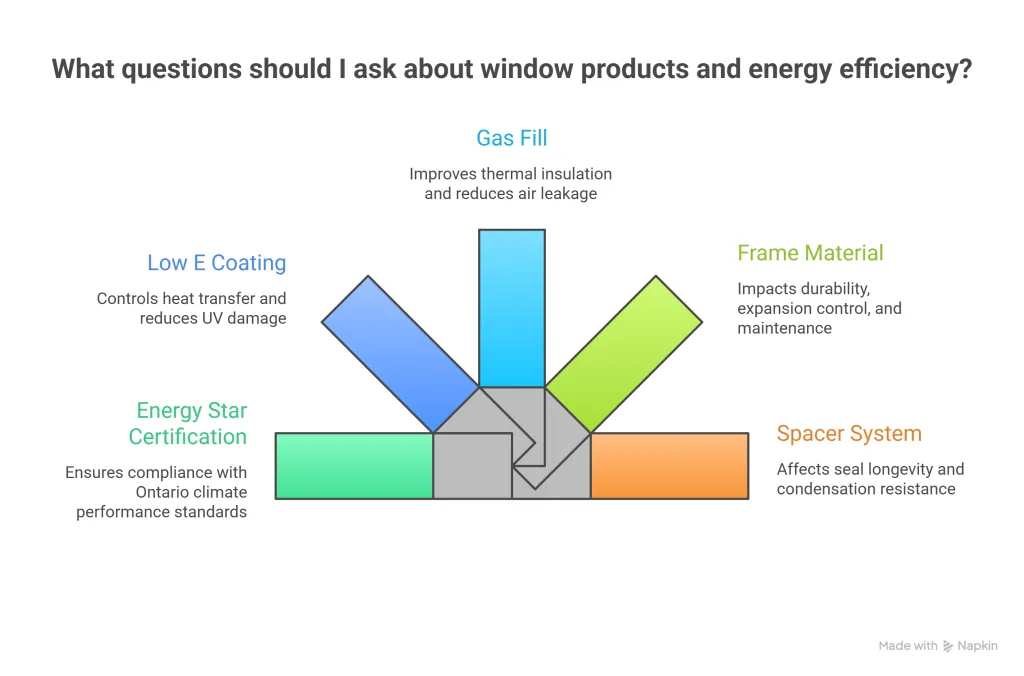
Product quality determines long term comfort, heating costs, and durability. Many homeowners assume all modern windows perform the same, but specifications vary significantly. Asking direct questions about glazing, frame material, and certification helps you avoid vague promises.
When comparing Energy Star certified windows Ontario homeowners should confirm compliance for their specific climate zone, not just a generic efficiency claim. Understanding the difference between triple pane vs double pane windows in Ontario installations is equally important, especially in colder regions of the GTA.
Below are the key questions to ask and what each answer should include:
|
Question to Ask |
Why It Matters | What to Look For |
|
Are the windows Energy Star certified? |
Ensures compliance with Ontario climate performance standards | Official Energy Star label and documentation |
|
Is the glass Low E coated? |
Controls heat transfer and reduces UV damage | Manufacturer’s spec sheet listing the Low E coating type |
|
Is argon or krypton used between panes? |
Improves thermal insulation and reduces air leakage | Written confirmation of gas fill in the contract |
|
What frame material is used? |
Impacts durability, expansion control, and maintenance | High-quality vinyl or MPVC with multi-chamber construction |
|
What spacer system is installed? |
Affects seal longevity and condensation resistance | Warm edge spacer system for better thermal performance |
These specifications directly influence heating efficiency, condensation control, and long-term structural stability. Contractors who cannot clearly explain glazing type, gas fill, or frame construction may not be providing premium systems.
High-performance products should align with standards similar to those outlined for energy-efficient windows, where insulation ratings and thermal design are clearly documented.
Detailed product transparency separates experienced contractors from sales-focused companies. Clear answers backed by written specifications protect homeowners from underperforming installations.
What Installation Method Will You Use: Full Frame vs Retrofit
The debate between full frame vs retrofit window installation is not about which is cheaper. It is about what your home actually needs. In Ontario, the installation method directly affects structural integrity, moisture control, insulation performance, and long-term durability.
The best window installation method Ontario homes require depends on the condition of the existing frame, the age of the property, and exposure to weather.
Here is how to evaluate both methods properly:
When Full Frame Installation Should Be Used
Visible or suspected moisture damage: If there are signs of rot, soft wood, mold, or previous leakage, the entire frame must be removed and inspected.
Older homes with settling or shifting: Properties in the GTA built decades ago often have uneven openings. Full frame allows proper re-shimming and structural correction.
Draft complaints or insulation failure: If cold air infiltration is already an issue, leaving the old frame in place may preserve existing insulation gaps.
Upgrading window size or style: Structural modification requires full frame removal to maintain proper anchoring and flashing.
Desire for maximum energy efficiency: Full frame allows updated insulation, proper vapor barrier integration, and tighter air sealing.
When Retrofit Installation May Be Acceptable
The existing frame is perfectly square and undamaged: No rot, no moisture staining, no structural compromise.
Relatively newer homes with intact flashing: If the original installation was done correctly and remains sound.
Minimal structural disruption preferred: Retrofit can reduce interior trim disturbance when the base frame is in excellent condition.
When Retrofit Should Be Avoided
- Covering up soft framing or hidden rot
- Ignoring insulation voids around the perimeter
- Attempting to reduce cost at the expense of long-term durability
In Ontario’s freeze-thaw climate, weak framing expands and contracts under temperature stress. Installing a new unit into a compromised frame increases the risk of air leakage and premature seal failure. The installation method should always follow structural inspection, not sales convenience.
For homeowners trying to understand the broader process, knowing what exactly does windows replacement involves clarifies why structural evaluation and moisture assessment must come before any installation decision.
What Should Be Included in a Window Replacement Quote?
A written estimate should do more than show a final number. A proper window replacement cost breakdown Ontario homeowners receive must clearly outline products, installation scope, and warranty coverage.
If details are vague, it becomes difficult to compare contractors or hold anyone accountable. Asking what should be included in a window quote protects you from hidden upgrades, downgraded materials, or unexpected add-ons later.
Below is what a transparent quote should contain:
|
Item |
Should Be Included | Red Flag If Missing |
|
Window model and series |
Yes | Vague descriptions like “premium vinyl window.” |
|
Glass specification |
Yes | No mention of Low E, gas fill, or pane type |
|
Installation type |
Yes | Full frame or retrofit not defined |
|
Disposal of old windows |
Yes | Listed later as an extra charge |
|
Warranty details |
Yes | Only verbal promises, no written coverage |
Beyond this table, the quote should also confirm:
- Number of units and exact sizes
- Frame color and hardware finish
- Interior and exterior trim work
- Estimated timeline
- Payment schedule and deposit amount
- HST clearly stated
Without itemization, homeowners cannot verify if they are paying for triple-pane glass or standard double-pane, or if the labor warranty is separate from manufacturer coverage.
Comparing written estimates becomes easier when you understand how window replacement cost is structured across Ontario projects. Transparency in the quote stage is one of the strongest indicators of professionalism.
If documentation lacks detail, accountability later may also be limited.
What Are the Red Flags When Hiring a Window Replacement Contractor?
Even experienced homeowners can overlook warning signs when evaluating quotes. Recognizing window contractor red flags Ontario residents commonly encounter can prevent costly disputes and unfinished projects.
The goal is not just to compare prices, but to identify behavior that signals risk. Knowing how to avoid window installation scams starts with spotting inconsistencies before signing anything.
Watch for these warning signs:
Large Upfront Deposit Requests
A reasonable deposit is standard, but demanding a large percentage before ordering materials can indicate cash flow problems or instability. Deposits should align with material ordering, not profit collection.
No Written Contract
Verbal promises offer no legal protection. The contract should outline the window model, glass specifications, installation method, timeline, payment schedule, and warranty terms. Missing documentation increases financial exposure.
No Proof of Insurance or WSIB Coverage
Contractors must provide proof of liability insurance and WSIB registration. Refusal or hesitation to show documentation exposes homeowners to liability if injuries or damage occur.
High-Pressure Sales Tactics
“Today only” discounts or urgency based on artificial deadlines are classic pressure methods. Professional companies allow time for review and comparison.
Vague Product Descriptions
If the quote lists “energy efficient window” without specifying glazing type, frame material, spacer system, or manufacturer, you cannot verify what you are purchasing.
Cash Only Pricing
Requests for cash payments to avoid taxes or paperwork remove transaction traceability and eliminate accountability.
Many installation issues homeowners face later are directly tied to these early warning signs. Patterns seen in window replacement mistakes often begin with unclear contracts or undocumented specifications.
Identifying red flags early protects your investment and reduces the likelihood of structural, financial, or warranty-related complications after installation is complete.
Why Choosing Panorama Windows & Doors Protects Your Investment
Hiring the best window replacement company Ontario homeowners can depend on is not about marketing language. It is about risk reduction, measurable performance, and long-term accountability.
Window replacement affects structural framing, insulation layers, moisture management, and resale positioning. The wrong contractor exposes your home to drafts, hidden rot, seal failure, and warranty disputes. The right contractor eliminates those risks before installation even begins.
That is why our clients trusts on Panorama Windows & Doors.
Below is a direct comparison that shows what you gain and what you avoid when you choose us.
|
What You Get With Panorama Windows & Doors |
What It Protects You From | Why It Matters Long Term |
|
Energy Star-certified window systems |
Overpaying for underperforming units | Verified climate performance for Ontario winters |
|
Low E + argon insulated glass packages |
Drafts and condensation | Lower heating costs and stable indoor comfort |
|
Full structural inspection before installation |
Hidden rot and moisture damage | Preserves framing integrity |
|
Clear full frame vs retrofit explanation |
Improper installation method | Stronger long-term durability |
|
In-house licensed installers |
Inconsistent subcontract work | Controlled workmanship standards |
|
WSIB and liability coverage |
Legal and financial exposure | Homeowner protection |
|
Detailed written quotes |
Hidden fees and vague upgrades | Transparent pricing |
|
Written product and labor warranties |
Verbal promises | Clear service accountability |
|
Project tracking and documentation |
Communication gaps | Organized installation process |
Professional window installation GTA homeowners expect should follow structure, not shortcuts. Panorama Windows & Doors’ process focuses on air sealing, perimeter insulation, frame anchoring, and long-term seal compression. These technical details determine how well windows perform during Ontario’s freeze-thaw cycles and high wind exposure.
Resale value also benefits. Properly installed high-efficiency windows improve curb appeal and buyer confidence. When documentation, warranty clarity, and performance specs are available in writing, the upgrade becomes an asset rather than a liability.
Final Thoughts
Choosing a window replacement contractor is not simply about replacing glass. It is about protecting insulation performance, structural framing, and property value. The right contractor provides documentation, explains installation methods clearly, and stands behind the work years after completion.
Panorama Windows & Doors combines Ontario-specific expertise, high-performance Energy Star products, licensed in-house installers, and structured project oversight. That combination minimizes risk, maximizes energy efficiency, and delivers installation quality that holds up through harsh winters.
Asking the right questions protects your investment. Choosing a contractor who can answer them clearly protects your home.
Written by Alex Soroka, Senior Project Manager.